No Such Thing as Perfect

Posted on by

The following piece was written by one of our patients, KC, a 32-year-old female from Wellesley.

Growing up as an athlete encouraged me to develop a commitment and eventually a passion for health and fitness. Over a year ago, that commitment turned into an unhealthy obsession. I lost the balance I once had and quite honestly it happened without me even realizing it. It took control of my life and isolated me from my friends and family and ultimately, it led me down a path of sadness and despair. This is my story of how strict discipline, unwavering dedication and the pursuit of perfection turned my otherwise healthy lifestyle into a battle with Orthorexia and exercise obsession.

I always looked to exercise for stress relief and an outlet when life became challenging and quite honestly, I still do. It was the one thing I could rely on. I felt a sense of calm when I planned strict workouts and meal plans. Sticking to them built my confidence, but failing to do so broke me down. I had to be perfect in order to achieve my goals of being fit. This discipline isolated me, but also made me feel better than everyone else. The more perfect I was, the more I separated myself from the average person. I looked down on everyone that didn’t share my passion for health and fitness.

I eventually developed such strict, unattainable rules failure was the only outcome. Each day I had to eat more cleanly and train harder than the day before. Even if I did achieve this for a period of time, I wasn’t capable of maintaining this intensity and in my mind the only solution was to be more strict. I started a food journal, something I have done my entire life off and on. In order to control my “bad” habits and cravings I felt it was necessary, although it only set me up for more potential for failure. The dieting world promotes food journals as a way to control calorie intake and unnecessary binges. I believe it can be a positive tool for those trying to develop better eating behaviors. However, this only contributed to my perfectionism, obsession and unrealistic ideals for myself. The more I recorded, the more I restricted.

At the time, I was experiencing discomfort with my stomach, which I blamed on my eating habits. It caused sleepless nights and uncomfortable days so I developed another rule, no eating past 8pm. This eventually ruined my social life. I had to rush home after work to eat dinner and declined all invitations to go out. For a while, I was convinced that it made me feel better physically, but the guilt I felt from avoiding parties, friends and anything social greatly affected my self-esteem. I justified it by telling myself I had to stick to the rules and staying out too late would no doubt ruin my workout the next day. The irony was despite following my rules and avoiding social settings my workouts weren’t always perfect. This only added to the growing feeling of failure and ultimately I wasn’t happy.

At this point, my dedication should have given me positive self-reinforcement and contentment. I was nowhere near content. I was exhausted all the time, injuries were creeping up, and I wasn’t enjoying myself at the gym like I once was. In addition, as hard as I was working out, I felt like my body looked awful and therefore I needed to push myself harder. This vicious cycle continued for months. I couldn’t look in mirrors because I felt like I wasn’t getting the results I should be. I avoided anything social because I felt like I needed to reach that level of perfection in order to feel good enough in my clothes to go out and be around people. I was stuck in a rut of failure, frustration and disgust. I found myself constantly comparing myself to others. I felt if I could maintain healthier habits than the people around me, I was ultimately more dedicated to fitness than anyone else.

One temptation that I always tried to control was my love for sweets. I figured if I eliminated eating them altogether I could get even better results at the gym. In reality, I didn’t get better results, I just deprived myself of something I enjoyed for the sake of achieving that perfect image. The interesting thing was I never defined what perfect was. I was constantly chasing something that wasn’t realistic. I just figured I would know what perfect felt like when I got there, but of course I only found sadness and disappointment.

My fitness became my identity. I figured it was the only real reason people liked me. They knew me as the fit girl. If I did overeat and not train hard enough, I wouldn’t be living up to that fit girl image. When I did overeat the punishment I put myself through at the gym was extreme in addition to depriving myself further of the nutrients to get rid of the heavy bloated feeling as a result of the overeating. My meal planning became so structured, I completely lost touch with listening to my body and I didn’t trust my body to make the right decisions. I would force myself to eat things I didn’t even want because they were ‘healthy’ and in my mind would get me closer to my goals. I planned my meals a week in advance and I ate based on the clock, not how my body felt. I had to eat 5-6 meals a day to get all the nutrients in I needed whether I was hungry or not. I realize now, I never enjoyed what I ate or really tasted my food. It took all the pleasure out of eating.

Despite the fact that I was so sad, I was still able to fake a smile. Everyone in my life knows me as a happy person so I had to keep that up. I’ve had people say to me, “You are so happy all the time, I don’t know how you do it”. Honestly, at this point in my life, I didn’t either. I was able to be happy on the outside, but miserable on the inside living a life of solitude. I knew after months of feeling this way something had to change. It was wearing me down physically, emotionally and psychologically. Initially, I was fearful if I got help I would be told that my lifestyle was crazy and obsessive and would be encouraged to drastically reduce my exercise intensity. Reluctantly, I went to therapy.

Talking about my fears and habits helped, but I didn’t change. I realized a lot of our conversations focused on my nutrition, especially when I talked about my stomach pains. My therapist encouraged me to see a nutritionist. I willingly agreed to this because it was such a passion of mine and maybe this person would be able to finally help me reach my goals. I didn’t realize it at the time, but it ended up being a life changing decision that opened my eyes to a severe pattern of disordered eating. I had no clue how much food was controlling my life. My rules and relationship with food took priority over everything in my life. Until I started talking about my feelings toward food and the role they played in my life, I had no idea how much I was under its control.

I was encouraged to read a book called ‘Health Food Junkies’, a book that focused on the eating disorder Orthorexia Nervosa. It was absolutely eye opening. I identified with every story and every statement made about what I now realize to be an unhealthy relationship with food. This really started my journey to truly becoming healthy in my mind and body. I had to relearn how to listen to my body. I had no idea what I felt like eating because I lost touch completely with trusting what my body was telling me. I remember being in the grocery store without my list and recipes for the first time in months and I felt completely lost. Despite feeling lost, I did have a sense of excitement going to the grocery store and shopping based on what I wanted to eat not what I should eat. To relinquish my rules was terrifying and I was afraid to fully trust myself. I wanted to get better, but was fearful that it would have a negative impact on my body. If I sounded conflicted, I was.

I will never forget the session when I was encouraged to eat a cupcake for dinner. Restricting myself from all sweets made me crave them more. I was excited to have this freedom. Within that next day, I bought two huge cupcakes and ate them on the way home in the car for dinner. I was finding sprinkles in my seat for days after. It was the first time I listened to my body in months and it felt empowering. I knew this was the turning point in my recovery. Cupcakes for dinner blew my rules out of the water and it felt pretty awesome.

I started to really believe that listening to my body was the way to achieve the results I wanted all along. It was telling me exactly what it needed to keep me healthy. My body told me when to eat and what to eat. I also started listening when it told me to take a day off from the gym. My social life and relationship with family were becoming strong again. I felt truly happy. For the first time in a long time, I realized being real was a much more fulfilling lifestyle than being perfect. To this day, I carry these valuable lessons with me. I am still one hundred percent committed to my health and fitness. It will always be a passion of mine, but I allow myself the freedoms I never did before because to me this is what it truly means to be healthy.

Health-Focused Weight Management

Posted on by

“So I was just reading the Huffington Post article that you guys posted on Facebook. Serious question, is it possible that the pride in your body movement has gone too far? I understand the evils of anorexia, bulimia, and other eating disorders, but being fat, especially as fat as the woman in that article, is bad, right? If I eat unhealthily and stop exercising, I gain weight (see, e.g., the 4 months after [my son] was born). So fat [name omitted] is more unhealthy than skinnier [name omitted] (to a degree, of course). And the people who I know that are overweight clearly have the worst eating habits and some of them have ended up with diabetes, high blood pressure, and cardiovascular problems.

“So why this big movement of pride in your body no matter how fat you are? I feel like it’s teaching a dangerous message. That lady in the bikini needs to lose weight by changing her diet and exercising more, doesn’t she? Being thinner will inevitably be better for her health and decrease the risk of her getting weight-related health problems. So why are we celebrating her being proud of how fat she is and then broadcasting to the world that she should be proud of her body no matter what?”

One of my best friends sent me the preceding email in response to me posting the Huffington Post article he mentioned on our Facebook page. We have been friends for decades and I know he asks these questions with honest, open-minded curiosity. Here are the points I wrote back to him.

1) Obesity is associated with health problems, but to my knowledge the legitimate research has never established a causal relationship despite attempts to do so. In fact, what the research has shown is that behaviors (smoking, physical activity, fruit and vegetable intake, proper sleep, limited alcohol consumption, etc.) are the real predictors of morbidity and mortality. When we control for these sorts of lifestyle choices, health outcomes are basically the same regardless of body weight.

2) Even if being obese was in and of itself a legitimate health problem, we really do not know how to help people lose weight and keep it off for the long run. The research shows that about 95% of the attempts people make to intentionally lose weight fail in the long run, and the majority of these people end up heavier in the end than they were at baseline. Weight regain can be due to behavior change, but it can occur even when the behaviors that yielded the weight loss are maintained. From an evolutionary perspective, consider that we are designed to keep on weight, not lose it, for the sake of survival. I have a patient who lost about 40 pounds, her motivation to keep it off is sky high, and she is very strict about maintaining the behaviors that got her weight down. Yet the weight is starting to creep back on slowly but surely. We can only do so much to fight biology.

3) When somebody tries to lose weight and it does not go as planned, the endeavor is not necessarily harmless. In other words, they do not automatically just return to baseline as if nothing happened. Weight cycling can cause everything from depression to metabolic issues like high blood pressure and high cholesterol. Given that 19 out of 20 weight-loss attempts fail, we need to really consider these risks.

4) The social stigma about being overweight pushes people into weight loss attempts, which we know are likely to fail them. We have a “war on obesity” in this country, which is ridiculous considering there are people everywhere making all sorts of behavior choices that could legitimately be considered unhealthy, but they do not face the same ridicule. Where is the outrage against people who do not get enough sleep? Why don’t we bitch about inadequate sleepers raising health care costs for the rest of us? Why don’t people who yawn in public seem to face the same bullying and looks of disgust that many obese people deal with on a regular basis? Our culture is so unaccepting of people who we deem overweight that we push them into weight-loss attempts that will likely leave them less healthy in the long run.

5) Because they are trying so hard to lose weight, Americans spend upwards of $60 billion annually on weight-loss programs and products. That’s insane. Imagine if we took those same resources and put them towards things that would actually help with health: cooking lessons, sports equipment, fruits and vegetables, walking shoes, gym memberships, comfortable mattresses, etc.

It is true that when somebody adapts unhealthy lifestyle choices, he or she might gain weight. If we have a baby and no longer have time for physical activity or proper sleep, for example, our weight might increase. The weight gain itself is just a symptom of the problem though, as opposed to actually being the problem. The real issues at hand are the lifestyle changes that happened to result in weight gain.

At the same time, we cannot conclude that somebody who is heavier automatically has an unhealthy lifestyle. Too many factors, including genetics, are in play. If we look at a heavier person and make any assumptions about how he or she leads his or her life, we are showing a prejudice that is as abhorrent and as any other stereotype.

The approach I take with my patients is to focus on behaviors, establish healthy lifestyle choices, and let the weight settle wherever it naturally belongs. Because our weight may or may not end up where we, our moms, our partners, society as a whole, etc. would like it to be, I encourage people to love and accept themselves no matter what they look like or weigh. That is why the Huffington Post piece and similar posts that confront weight stigma and call for size and weight acceptance are so important.

Day 67: Marathon

Posted on by
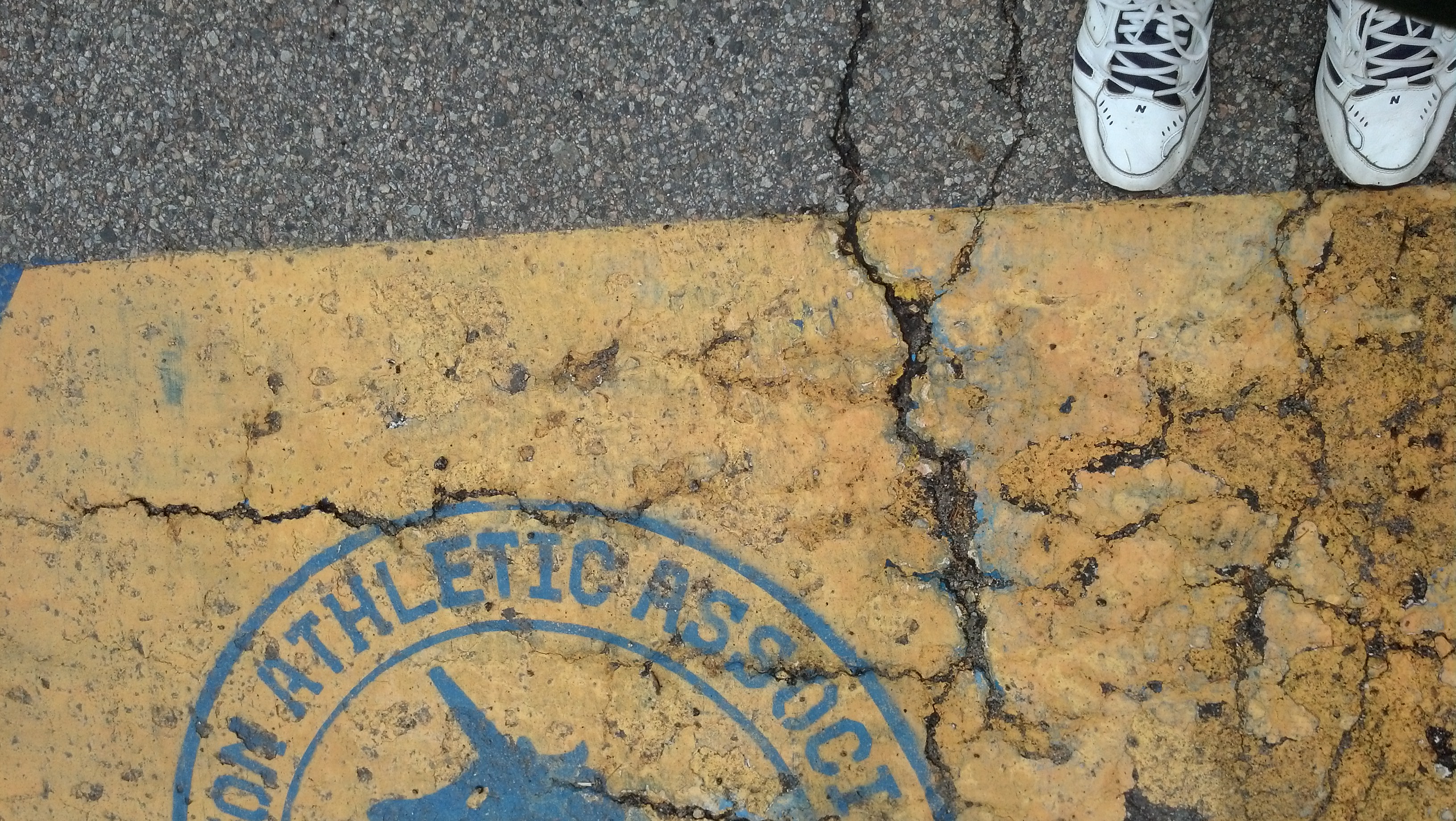
Boston Marathon starting line, Hopkinton

Selfie of my feet at the Boston Marathon starting line, Hopkinton

A little over a month ago, my surgeon gave me permission to slowly ride the recumbent exercise bike and perform basic upper-body resistance movements with light hand-held weights. The doctor’s clearance for new exercises is mandatory, but so is my body giving me positive feedback in response to said activities. Unfortunately, I only had one of the two. After a few times of giving these exercises a try, my back pain seemed to worsen, so I put the bike and weights on hold and returned to exclusively walking.

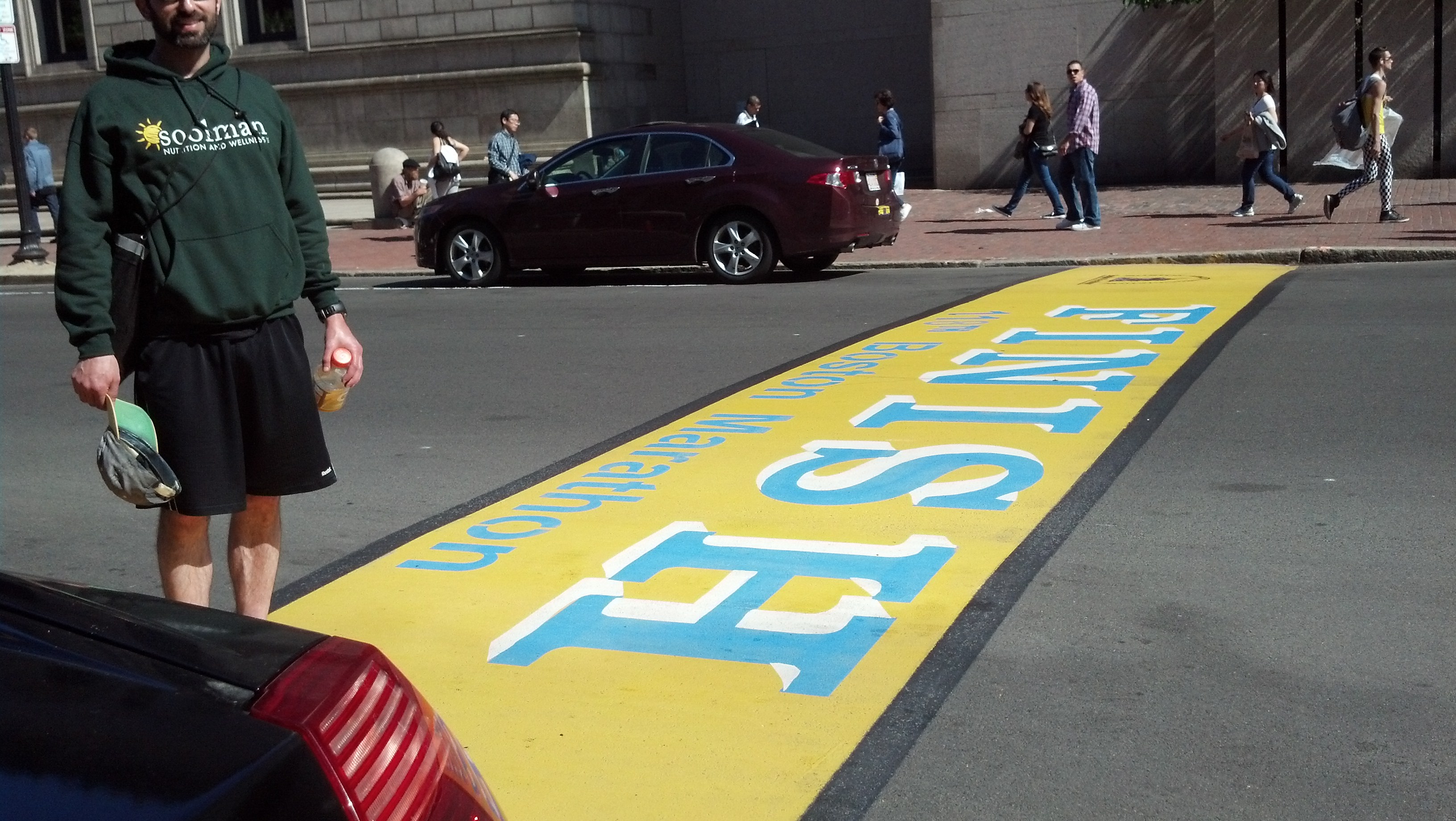
Because several walks in the range of 12 to 16 miles felt fine and left me feeling like I could have done more, I decided to go a bit farther today. Early this morning, my back brace and I took the first commuter rail train of the day out to Ashland, where I met the taxi that then dropped me off in Hopkinton, right at the starting line of the Boston Marathon. 7:28 later, I walked across the finish line in Copley Square.

Boston Marathon finish line, Copley Square

Boston Marathon finish line, Copley Square (Photo courtesy of a tourist who was nice enough to take my picture after I told her I had just finished walking the entire route)

Looking the Part

Posted on by

Wow, I am hard pressed to remember an instance when something I read made me as angry as Juliann Schaeffer’s article in Today’s Dietitian entitled “Dietitians and Their Weight Struggles.”

In summary, the article contains quotes from dietitians who offer their opinions as to whether or not a dietitian’s weight and appearance should matter. Although the piece improves at the end when some sanity and rationality is injected into it, the beginning quotes from one of my fellow dietitians are so shamefully off base that I feel deeply embarrassed to be associated with her.

“If someone has a weight issue, then in my opinion, they should choose a specialty that does not conflict with being overweight.”

“If you can’t make it work for you, how can you make the case for someone else?”

“. . . the reality is that health care is a business, and people do judge you by appearance. Is it right or wrong? That doesn’t make a difference. It’s a business, and it is what it is whether we like it or not.”

“I wouldn’t think much of advice from a cardiologist if I knew he had had a heart attack.”

So wait, are we dietitians supposed to list our BMIs on our resumes and websites now, or how does this work?

It is one thing for some personal trainers, chiropractors, life coaches, “nutritionists,” therapists, doctors, and other dietitian wannabes to go outside the scope of their expertise and give harmful dietary guidance, but when an actual dietitian represents the profession the way she has there is just no excuse for it. This is our wheelhouse. We should be better than that.

When I was an intern, I had a rotation in a bariatric surgery clinic where two dietitians worked. One was heavier, one was leaner. Some patients did not want to work with the heavier one because they questioned, “Look how heavy she is; how can she possibly help me?” Yet other patients did not want to work with the leaner dietitian because they worried, “Look how skinny she is; how can she possibly relate to what it is like to be fat?”

Last year, a new patient told me she almost cancelled her appointment because she was intimidated by what a “great athlete” I was. Just a few months ago, another new patient came to me all impressed that I had “beaten cancer.” Well, no, I did no such thing. She had misunderstood my online autobiography. When I told her that, she deflated like a balloon.

Let’s get real for a moment. The whole notion that a practitioner has to look or behave a certain way in order to help patients is incorrect. Out of all the questions I asked the surgeons I met with before my most recent back surgery, I never thought to ask who among them has back problems. But I should have because if a surgeon has back problems then it is logical to conclude he or she cannot help me with my issues, right? Or wait, I want a surgeon with back problems because he or she can relate to my experience, is that how it goes?

How about just finding the surgeon whose approach, experience, and demeanor made me feel most comfortable and confident? I know, crazy me and my outlandish notions.

During my first year as a personal trainer, few members were interested in my services. Although I had good relationships with many of them and they routinely asked me questions about exercise, few were willing to cross the line of actually hiring me. However, after I took two months off to ride my bike across the country, suddenly members were booking sessions with me left and right and my boss began to refer new clients my way, too. Other trainers treated me and my opinions with more respect. The gym even gave me a raise without me asking for it.

Come on.

Sure, more money and clients were great, but the driving force behind the upturn in business was so ridiculous that I felt insulted. It took riding my bicycle 4,000 miles, up and down mountain ranges, through all sorts of weather, for my expertise to be recognized and taken seriously? The ride did not make me a better trainer. If anything, I was a worse trainer after my trip because I was rusty from not having worked in two months. But hey, perception is all that matters to some people.

Right now, I have a patient who wants to be a CrossFit coach and feels she needs to lose 15-25 pounds in order to be taken seriously by potential clients. Sure, she has room for changes in her lifestyle, just like we all do, but she generally eats well and takes great care of herself. As disappointing as it is for her to hear, it seems her body just naturally belongs 15-25 pounds heavier than she would like it to be. Do I push her further down the path she feels obligated to follow, risking perhaps disordered eating or an eating disorder, as she sacrifices health for a number and a look, or do I guide her towards the reality that she can be a great trainer no matter her weight and appearance?

Due to my surgery, it has been seven weeks since I lifted weights and did any physical activity in earnest. Muscle atrophy is setting in. My shoulders and chest are smaller. My six pack is gone.

Am I a worse dietitian now than I was two months ago?

What if you did not know that major surgery had affected my fitness and you came in here and saw a scrawny dietitian without any context? Would you have less confidence in me than if you knew about my operation?

What if I had not undergone surgery and I just decided to take two months off from working out?

What if I had a healthy relationship with both physical activity and food, but my body just happened to be thinner, less muscular, or heavier than society feels its dietitians should look? Would you go elsewhere?

I have blogged about my athletic accomplishments, such as my mountain running, on a small handful of occasions because it can enhance patient care for them to understand that I am a human being with a life outside of this office and I face challenges just like everybody else. Perhaps patients garner some inspiration from those postings, but if anybody reads one and then comes to see me with the mindset, “Jonah is thin and Jonah is an athlete; therefore, he can help me,” God, that would just make me want to take all of the posts down. I just cannot be part of that act.

The purpose of self-disclosure is to enhance patient care, not to serve as an advertisement, not to capitalize on misconstrued ideas, and certainly not for a practitioner to defend or justify his or her behaviors or body shape.

I disagree with the notion that health care is a business. The first priority should be patient care, not money. If the dietitian I quoted earlier had her priorities in order, she would be helping to reeducate her patients and change a culture of misunderstanding rather than playing into it for profit. Giving people what they want and expect for the sake of financial reward does not justify providing poor care and perpetuating a myth.

Or maybe I should just play along and take up steroids, lest patients go elsewhere because I no longer look the part, right?

Come on.

Day 26: Mindful Movement

Posted on by

This morning I went for a 14-mile walk, which was miles farther than I had intended when I left home. Carrying my MBTA pass with me, my plan was to walk from station to station in Newton and then take the green line home whenever I got tired. But the fatigue never came, so I ended up walking home instead.

This afternoon, I called my surgeon’s office just to make sure it is okay that I am walking that kind of distance at this point in my recovery. They told me that 14 miles has to be some sort of record for this soon after major back surgery, but as long as I am feeling good (which I am) then they see no problem with it.

Joanne and I talk about mindful eating with our patients, but the concept of mindfulness extends beyond just dietary habits. Adjusting mode, frequency, duration, and intensity of physical activity yields all sorts of permutations of movements, and our bodies are great at giving us feedback regarding which ones work for us. We just need to make sure we listen.

Approaching physical activity with a spirit of mindfulness means paying attention to and honoring the feedback that our bodies give us in response to our movement choices. Today, for example, I was fully prepared to end my walk as soon as my body told me it was time to stop, but instead I felt great so I honored that and kept going. Yesterday, in contrast, I was hoping to go for a long walk, but my left heel felt uncomfortable just a couple of blocks from home, so I turned around and called it a day. Although I was disappointed to go home early, better to nip whatever it was in the bud and let it heal immediately, rather than push it and risk a long-term injury.

Besides injuries, other consequences can arise from not being mindful with our movements. We risk increased stress, overtraining, undertraining, burnout, and simply not enjoying ourselves. Although I was never the type of personal trainer to push my clients past the point where their bodies were telling them to stop, holding myself to the same standard and listening to my own body’s feedback has been a challenge at times, and I have paid the price via overuse injuries and getting sick of activities I once enjoyed. Moving our bodies can, and should, be fun.

Given my personal challenges, I consider yesterday’s aborted walk a greater accomplishment than today’s 14-mile trek. By listening to my body and honoring its signals, even as it was telling me something I did not want to hear, I put myself in a position that made today’s walk possible.

The Best Way I Know How

Posted on by

Q: Hey, whatever happened to your stated intention of running the Boston Marathon this April to raise money for the victims of last year’s bombings?

A: Back surgery put an end to those plans. Although I am disappointed that I am unable to participate in the race in the fashion that I envisioned, my intention to form a fundraising team to benefit the victims had nothing to do with putting myself in the spotlight and little do with running. Rather, I was just trying to help in the best way that I knew how.

My ability to run might be temporarily on hold, but the spirit of my intentions and my desire to help the victims still holds true. Out of all the important charities that are fielding marathon teams, at least two, The One Fund and Team Collier Strong, directly grew out of last year’s tragedies, so I have thrown my support behind them and the One Run for Boston event.

As time elapses after an event that once gripped us so tightly, new stories and circumstances phase it out from the forefront of our minds. Most of us have the luxury of moving on, while those directly impacted by the event follow a much different trajectory. To the credit of people all around the world, The One Fund successfully raised millions of dollars for the victims in the immediate aftermath of the tragedy. However, because their costs are ongoing, so should our support.

In addition to our financial support, Joanne and I look forward to cheering on runners as they finish the Haunted Mile and make their turn onto Beacon Street. Back surgery or not, I can still help in the best way that I know how.

Day 15: Acceleration

Posted on by

A few years ago, I spoke with a woman at the gym about the time she had to take off from work for cancer treatment. Upon her return, some of her co-workers treated her as if she had been on vacation, which infuriated her. As she explained to me, and I know first-hand, there is a big difference between using vacation time and going on medical leave.

Spending all day on the couch watching television might be fun and relaxing when you do it by choice, but being forced into it because there is virtually nothing else you are capable of doing is an entirely different matter. My first week home from the hospital was the slowest seven-day span I can remember.

As that first week came to a close, I made the decision to focus less on what I could not do and to instead emphasize the small indicators of progress that came with each passing day. Each evening right before going to bed, I wrote myself a quick note about what I had accomplished that day.

My whole perspective shifted. Powered by a more positive outlook, I have nudged myself to do just a little bit more each and every day, and the results have come at a rate so accelerated that I never would have expected it. Just one week ago, for example, I went outside for the first time after my operation and slowly shuffled around the block with Joanne’s help. Today, I walked six miles by myself.

Yesterday was my first post-operative appointment with my surgical team and they could not believe how well I am doing. They were floored that (1) I am already off of all of my pain medications, and (2) that I have been off of them for a week already. My baseline fitness going into the operation and my generally-healthy diet, they said, are likely significant factors into why I am recuperating so quickly.

That is probably true, but I like to think that my resolve to get off the couch and do something productive with my days also has something to do with it.

Day 11: Small Victories

Posted on by

My spirits have been pretty dismal, to be honest. As somebody who values independence and taking care of myself, being stuck at home and needing my wife’s help for nearly everything I do has been sad and depressing.

On the other hand, I am mindful of my own advice: long-term success grows out of patience, perseverance, and the tempered resolve to wake up each morning and inch just one day closer to the goal. With that in mind, rather than focus on what I cannot do right now, a much more positive mindset is to focus on the small indicators of progress that have come with each passing day:

Day 7: I was able to get up and sit at my computer for the first time since my surgery.

Day 8: I was able to step outside for the first time since getting home from the hospital.

Day 9: I was able to walk around the block by myself.

Day 10: I was able to go for two walks in a single day.

These are basic activities of daily living that never would have crossed my mind as anything special before my surgery, but now they are small victories showing me that I am well on my way to regaining my freedom and independence.

Everybody Belongs Somewhere

Posted on by

“I have chosen to reword and publish the following text that, when I first wrote it, was never intended for posting.”

Our patients come here with all sorts of opportunities for improvement, but the common theme is that virtually all of these conditions require long-term management. Eating disorders can be worked through and overcome, cholesterol levels can be improved and maintained, but nobody accomplishes these or similar feats after a single session. Whatever our challenges, long-term success grows out of patience, perseverance, and finding a sustainable balance that enables us to manage our conditions in the context of our lives.

Practitioners are no different. Taking care of my chronic back woes involves the same sort of day-to-day management and balance that our patients face with their own conditions. Just as many of our patients do, I have my good days and my not so good days, and my motivation oscillates from time to time. Being a health care professional does not exempt me from being human.

Self-disclosure is a tricky issue, and while there are certainly wrong ways to go about it, there is not a singular right way either. My approach has always been that if sharing information about myself enhances patient care, then I am open to it.

For that reason, I have chosen to reword and publish the following text that, when I first wrote it, was never intended for posting. Meant for nobody but myself, it was an internal document, a tool in my decision-making process as I weighed whether or not to have another operation on my back. Writing out the intertwined relationship between my health and the sport that I love helped me to resolve my ambivalence, move from Contemplation to Preparation, and make a decision regarding surgery.


“The sport came naturally to me and I instantly fell in love with it.”

At a young age, I discovered that nowhere feels like home like a tennis court. My brother, four years my senior, was a standout baseball player and I had to go to virtually all of his games, or at least it felt that way. Back then, I appreciated neither the sport of baseball nor the importance of supporting a family member, so I spent the games sulking in boredom. In order to give me something to do, my mom gave me her old wooden tennis racquet and let me hit against a backboard near the baseball diamond. Anybody at my wedding who saw me out on the dance floor with Joanne can attest that I am one of the least coordinated people to ever walk the earth, but for some reason I had a specific talent for hitting a tennis ball. The sport came naturally to me and I instantly fell in love with it.

Hitting against the backboard segued to Park and Rec group lessons and then to private lessons with Ben, a family friend just a few years older than me who was one of the best players in town. My parents, neither of whom had a whole lot of experience with the sport, bought a couple of racquets for themselves so they could hit with me. One summer day when I was probably 13, my father and I finished hitting on the courts next to Needham High School and sat down on the steps that overlook Memorial Field. He told me that if I wanted to play for the team when I got to high school, he thought I could make it. I didn’t believe him.


“Approximately 20 spots later, in next-to-last place, was my name.”

While I had a talent for hitting ground strokes, tennis involves a whole lot more than that. When I got to high school and tried out for the team, I felt overmatched by players with more well-rounded games and experience. After Coach Shea cut my friend Todd, who in my mind was a much better player than I was, I figured I was destined for the same fate. Not until Coach assigned me a locker did I realize I had made the roster. He posted a ladder that ranked everybody on the team relative to each other. Ben was first, a spot he most certainly deserved and would ordinarily have occupied anyway, but in this case it was just symbolic, as he was unable to play due to a brain tumor. Approximately 20 spots later, in next-to-last place, was my name.

My first match was in Walpole on a chilly March day in 1992. I paired with my friend Josh, the sole player on the team ranked behind me, for a doubles match. Our opponents were two disheveled kids who kept on complaining that we had to hurry up because they had to get to some store before it closed. We managed to hold serve once, but that was all as we lost the one-set match 1-6. Before I knew it, we were off the court and back on the bus with our teammates, almost all of whom had won their matches. One of them greeted us with, “Wait, you LOST???”

Tryouts were rough my sophomore year, too. Still one of the weaker players on the team, I now had to compete for a roster spot against the incoming freshman as well. After I lost a “challenge match,” a one-on-one battle that determines who moves up and down the team’s ladder, against one of those freshmen, Coach told me he was considering cutting me. He let me stick around, but I had a tough season and finished with around a .500 record.


“With all of the losses I have had in approximately two decades of playing competitive tennis, this is the one that I wish I could have back.”

During tryouts my junior year, I drilled one of my teammates in the crotch with a two-handed backhand when he came to net. The ball’s direction was a complete accident and I felt bad that my shot put him on the ground in pain. On the other hand, that backhand got Coach’s attention. Every rep of my off-season weight training went into that passing shot. Coach knew I had worked hard coming into the season, and it proved to be the only year out of my four in high school that he gave me a spot on the roster without hesitation.

Early in the season, I played a challenge match against Andy, a very solid player with an excellent game. To the shock of everybody, including Andy and myself, I beat him. Upon leaving the court, Andy asked our Assistant Coach, “What’s he doing on JV?” As a result of my win, I shot up the ladder and played my first varsity match, second doubles, after a teammate was out sick.

A short time later, I was up against Jed, Ben’s younger brother, in another challenge match. Like Ben, Jed was an incredible player and I thought I had no chance. My intimidation showed as I lost the first set 0-6. Coach pulled me aside, calmed me down, and told me to play like I had against Andy. I won the second set. In the third set, I had a 5-3, 40-15 lead on Jed’s serve. Double break point, double match point, double by-far-the-biggest-victory-of-my-life point.

Jed took his time, methodically pacing in small circles behind the baseline before stepping up to serve. As the point evolved, he came to net and slammed an overhead that bounced high above my outstretched racquet. No problem, I thought; I still had match point. Jed again took his time to focus. He came in again and my down-the-line backhand passing shot failed to clear the net. Deuce. The self-doubt returned. Jed won four straight games to take the final set 7-5.

It’s not like I tanked. I tried my best during those last four games, but in my heart I felt that my window of opportunity had closed and that affected my play. To cap it off, I double faulted on Jed’s first match point. None of my teammates or coaches said one word to me after we walked off court. We all knew what had happened: I had choked. I had choked big time. With all of the losses I have had in approximately two decades of playing competitive tennis, this is the one that I wish I could have back, to see how my tennis future would have changed had I beaten a player of Jed’s stature at that point in my career.


“In a short span of time, my lack of confidence had been replaced by an exhibition of arrogance so obnoxious that I am still embarrassed of it to this day.”

Next season, with many great players still ahead of me on the ladder and a coach’s policy against playing seniors in JV matches, I had no spot on the team. Coach pulled me aside and explained that after three years together he felt too badly to cut me, but I should cut myself because I was not going to play. I refused to do so and remained on the roster as a practice player. After one of our best players was kicked off the team, I found a spot on varsity playing first doubles with Andy.

Our games blended nicely. My consistency and his power complemented each other well. Although we had both been on the team for years, we never really got to know each other until we were paired up for doubles. It turned out that we worked exceptionally well together. We each were capable of making the other one laugh, focus, calm down, fire up, whatever was called for in the given moment. Together, we had a swagger that neither one of us had on our own.

By the season’s midpoint, he and I were undefeated together. We were the top-ranked doubles team in our league and considered one of the best in the state. After defeating another highly-ranked doubles team in Brookline one afternoon, we walked off the court with my pointer finger held high in the air so everybody in attendance knew who was number one. In a short span of time, my lack of confidence had been replaced by an exhibition of arrogance so obnoxious that I am still embarrassed of it to this day.

After Andy and I lost a couple of matches, including one to a very weak tandem we should have dominated, Coach thought perhaps it was time to shake things up. While traveling home from a match, he sat across the bus aisle from me and asked what I thought about playing singles. Whatever the team needed, I told him, but my smile gave away the truth that I had badly wanted to be a varsity singles player for years. Coach shuffled the lineup and slotted me in at third singles, which remained my spot for the rest of the season while our team made it all the way to the state quarterfinals.
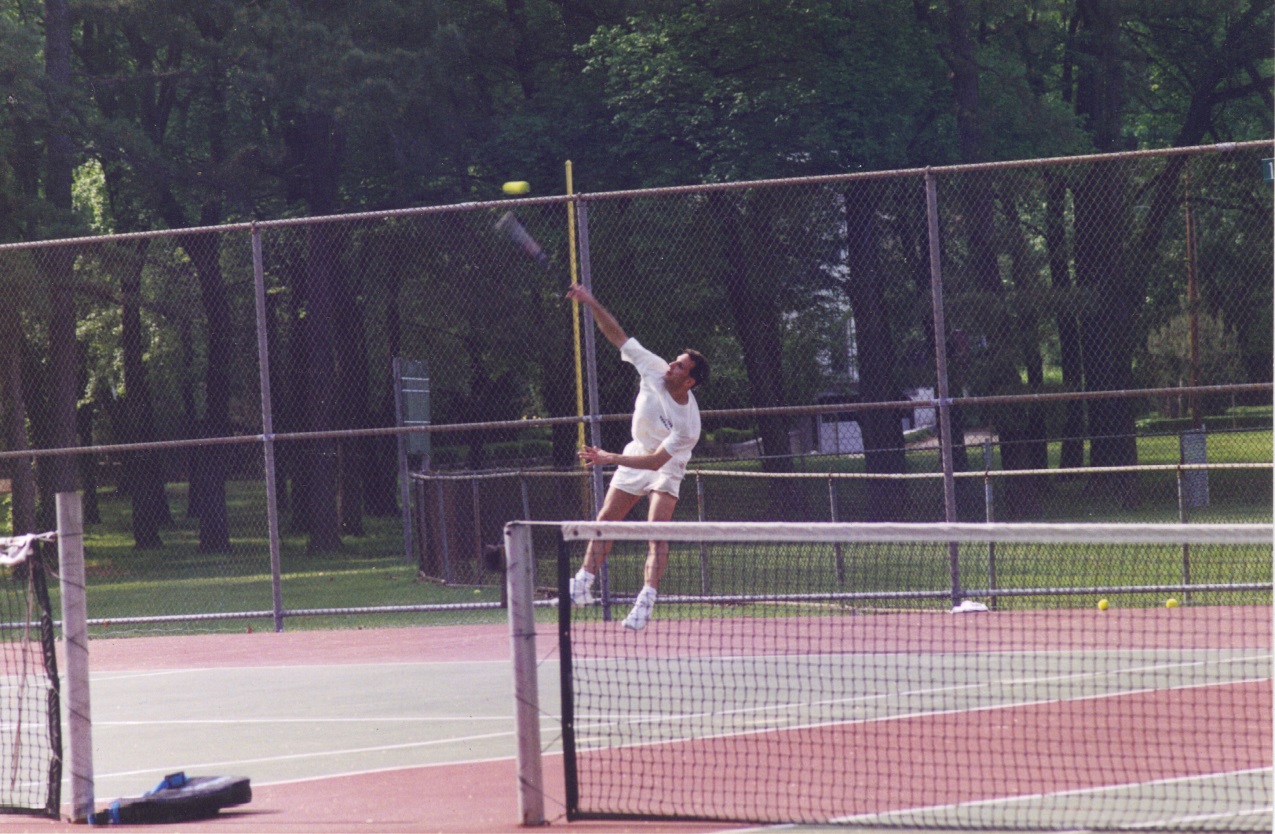
Playing third singles for Needham High School, 1995

Playing third singles for Needham High School, 1995

The last match of my high school career, I lost 6-1, 4-6, 4-6 on the same Brookline courts where I gave that number-one gesture earlier in the season. Served me right. Karma. However you want to say it, the bottom line was there was some justice in losing a tough match to that team on that court after the stunt I had pulled.

In both the second and third sets, I was serving at 4-4, 30-all. Both times, my opponent won the pivotal fifth point, broke me, and went on to win the set. In tennis, all points are not created equal. One can lose the majority of points or games in a match, yet still win it. In fact, I outscored my opponent in games (14 to 13) this particular day, but he was the one who walked away victorious. The outcome of matches often hinges on how you respond in just a few key situations. Either you rise to the occasion and respond appropriately or you do not. Such is tennis, and such is life.


“I just could not do what they could do; it was like we were playing two different sports.”

Late that summer, I arrived at Tufts University for freshman year and attempted to make the NCAA team as a walk-on. Approximately 60 of us were trying out for two open spots on the roster. I made the first wave of cuts, but did not survive the second. Still, I was not ready to give up on the idea of playing college tennis just yet, so I kept on showing up to the team practices and hit with the guys. Not until Coach Watson gave me a uniform and put me in the lineup for a JV match that spring did I realize he had reconsidered and added me to the roster.

College tennis was an enlightening experience. All of my teammates were better than me, most of them by a lot. Each of them had been the best player in his high school, a status to which I could not relate. Incapable of even holding my own against most of them, I frequently got blown off the court in practice. I just could not do what they could do; it was like we were playing two different sports. The holes in my game that I had been able to work around in high school were routinely exposed at the college level. Coach did not understand how I often failed to execute shots and plays that were so easy for my teammates. His frustration with me showed through sometimes, not in a Bobby Knight sort of way, but more through glares and occasional harsh words, yet he kept me on the team and for that I was grateful.

While I did manage to win some singles and doubles intercollegiate matches, I cannot specifically remember even one of those victories in any sort of detail. By and large, the fragments of matches that I do recall have coalesced into a hazy memory of getting destroyed.
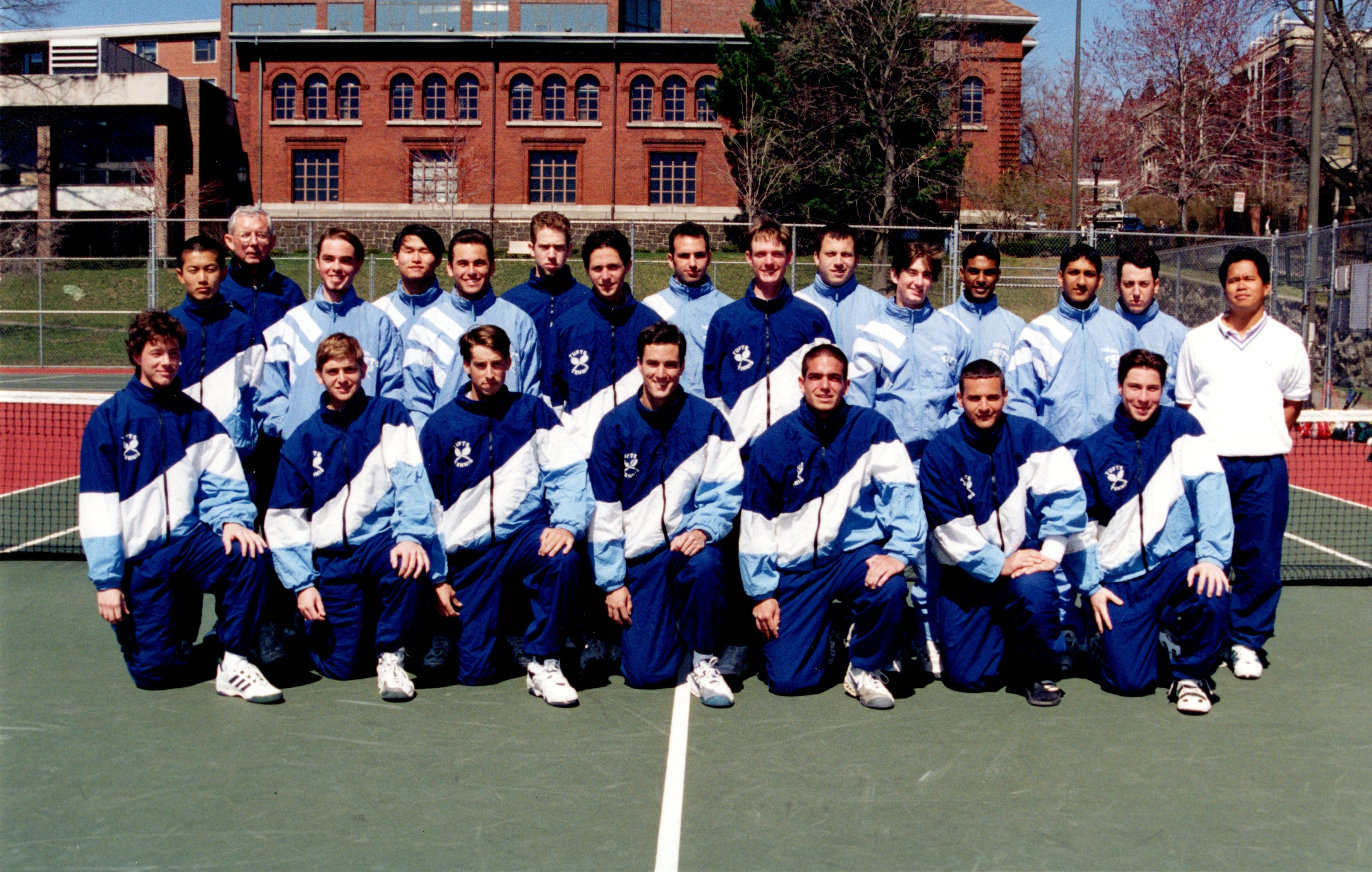
1997 Tufts University NCAA Tennis Team (I am in the center of the back row.)

1997 Tufts University men’s tennis team (I am in the center of the back row.)


“I could not stand at the sink and shave without having to take a break in the middle to stretch.”

During the offseason between sophomore and junior year, I trained like a madman. Although I did not look it, I had gotten myself freakishly strong. In the weight room, guys much bigger than me used to watch with confusion as I bench pressed nearly twice my body weight. I sprinted up hills, ran demanding interval workouts that I remembered from my high school track days, performed footwork drills at a court near my house, and practiced with the Tufts Assistant Coach who lived in a neighboring town. That pre-season, I held my own with, and even beat, some of my teammates who had blown me out of the water the past two years. Playing as well as I was, I thought I had an outside shot at even moving up from JV and playing some varsity matches.

Before the season began, Coach insisted that I see a doctor for my long-standing back pain. Since I was 14, I had lived with chronic pain that often radiated down my right leg. My pediatrician never seemed to see it as a big deal and therefore neither did I. By that pre-season, however, the pain was so bad that I could not walk the two blocks back to my dorm after practice without needing to stop and stretch on the sidewalk. I could not stand at the sink and shave without having to take a break in the middle to stretch against the bathroom wall. When Coach ordered me to see a specialist before he would clear me to play the season, I told him it was a waste of time. I was fine, I insisted.


“My new primary care doctor told me I had post-traumatic stress disorder (PTSD). Although some of my friends could tell I had changed, I largely kept my struggles to myself.”

A sudden look of seriousness spread across said specialist’s face as he held up the x-ray he had ordered and viewed it for the first time. My life has never been the same since that moment. To my complete surprise, it turned out that I had a tumor on my spine. Instead of fretting over whether I would make varsity or again be on JV, I worried about whether the tumor was benign or malignant. While my teammates prepared for the season, I did my best to ready myself for immediate surgery.

I remember looking out the window of my hospital room a day or two after my operation and watching the red line trains ride in and out of the Charles/MGH stop. “Those passengers are participating in life,” I thought, while I was absent. My classes were still going on, my teammates were still practicing, yet I was hospitalized. Back when I was in high school, being home sick from school yielded a sort of unsettling depression and anxiousness because I was not where I belonged; I was not living my life. Being in the hospital generated that same feeling, but to an exponentially-greater magnitude.

Death is a topic to which I had given little thought until I experienced anesthesia. My expectation was that being under would mimic sleep. Instead, there was no dreaming, no indications at all from my vantage point that I was in existence. I closed my eyes, then opened them, and in between was a void of which I had no memory. It was as if for that period of time I wasn’t – period. I thought to myself, “This must be what death is like.”

My hospital roommate was in bad shape. The brain tumor that he previously had removed had grown back and he had to have it removed for a second time. This time, he lost vision in one of his eyes as a result. While my brother and I were going for a short walk down the hospital’s corridor, a dead patient was wheeled past us on a gurney.

After what I witnessed and went through myself, I was scarred, more figuratively than literally, and I felt very, very, very mortal. After I got home, I assumed the worst. A headache meant a brain tumor. Abdominal pain meant colon cancer. My new primary care doctor told me I had post-traumatic stress disorder (PTSD). Although some of my friends could tell I had changed, I largely kept my struggles to myself. Only my doctor and my girlfriend knew the internal turmoil I was experiencing.

In hindsight, I am surprised my doctor did not send me to a therapist, or that I did not figure out on my own that I needed help. Part of me rejects the PTSD diagnosis because there are people out there who truly have PTSD – war veterans, rape survivors, first responders, etc. – and their ordeals should not be disrespected, cheapened, or watered down by my experience. Whether or not I really had PTSD, the fact was that I was struggling and it took me the better part of a decade to get over the emotional toll of my surgery. Years went by before I could ride the red line through that Charles/MGH stop and even look in the direction of Mass General without triggering horrible memories of how it felt to be on the other side of those hospital windows.


“That was no way to live no matter what my abs looked like.”

While I did return to the Tufts tennis team a couple months after my operation, by season’s end it was clear that my back was no longer fit for the sport. The decision I knew I had to make was so difficult for me that I could not even express it to Coach Watson face to face. Instead, I wrote him a letter thanking him for everything and explained why I had to leave the team. I sat out what would have been my senior season.

For the next four years, I played no tennis except for rare occasions when I casually hit around with a friend. Fueled by an intense fear of getting sick and dying, I spent these years doing everything I could to take care of my health. Although I hated swimming, I picked it up on the advice of my neurologist. I performed every core exercise I knew and added new ones along the way. Even though it meant sometimes going to bed when it was still light out, I spent nine hours in bed each night, every night. I paid more attention to my eating than I have at any other time in my life, including now. Guys in the locker room used to talk about my abs.

In the film Across the Universe, Jude says to the Vietnam veteran, “You don’t seem too messed up,” to which he responds, “Well, everything below the neck works fine.” Similarly, even though my emotional health was in disarray, I looked okay from the outside, and my back and body as a whole were getting stronger.

I often talk with my patients about living life in balance. At that point in my life though, I was anything but in balance. After turning down plans with friends so I could exercise after work and go to bed early, some of them began to distance themselves from me and stopped extending invitations. My insistence on only eating food I had brought from home kept me from joining co-workers for lunch and my rapport with them weakened. My stress level was so high that I often woke up nauseous in the middle of the night and sometimes vomited. A bottle of Maalox tablets was a permanent fixture at my bedside. While my physical fitness was fantastic, my life was filled with rigidity, unhappiness, and a whole lot of fear. That was no way to live no matter what my abs looked like.


“They were telling me their game plans without even realizing it.”

After four years away from tennis, my back was feeling well enough where I felt ready to try the sport again. I moved to western Massachusetts, joined a new gym, and saw on the bulletin board an ad looking for players to join a men’s United States Tennis Association (USTA) team. The captain, Scott, and I got together to hit at Hampshire College. Having not played in so long, I was terrible. As if I was playing the sport for the first time, I had no idea where the ball was going when it left my racquet. Still, Scott let me on the team and he introduced me to some very nice teammates with whom I began to regularly practice. The rust wore off.

My time away from playing the sport afforded me an opportunity to see it from a different perspective. Not just to see it, but to really consider it, to experience tennis from a macro vantage point from which I had never viewed it before, to understand the flow of the game, why players do what they do in certain situations, what separates the winner from his or her opponent, and other complexities that I never took the time to examine and absorb when I was too busy focusing on my first-hand experience.

Although I never was again the same player physically that I had been in college, I returned to the sport a much more intelligent player. I was more observant than I ever had been when I was younger. Subtleties often gave away my opponent’s next move. The opening of his racquet face signaled a drop shot. Like a change in arm slot tips a pitch, a slight shift in grip indicated the kind of serve coming my way. A quick peak out the corner of my opponent’s eye revealed his target spot. Other times it might have been what a player did, or did not do, in warm ups to hide a weakness or show off a strength. Small talk before the match or on changeovers, whether he looked me in the eye or not, and his posture, these were all windows into his state of mind. They were telling me their game plans without even realizing it.

That’s not to say that I was always able to take advantage of these insights or that my own game was absent of faults. Certainly, I ran into players who exploited my weaknesses, outsmarted me, or blew me off the court with power, but those were the exceptions rather than the rule. After going 11-1 for Scott’s team, I moved up to a more challenging USTA league the next season. The players could do everything a little bit better than in the previous league: move quicker, hit harder, play more consistently, etc. After losing two matches early in the season, I adjusted and went on a run. Next season, I was undefeated and had more match wins than I did double faults. My baseball-playing brother got a kick out of it when I compared my statistical achievement to Bret Saberhagen’s 1994 season with the Mets when he had more wins than walks. All told, three years went by before I lost again.
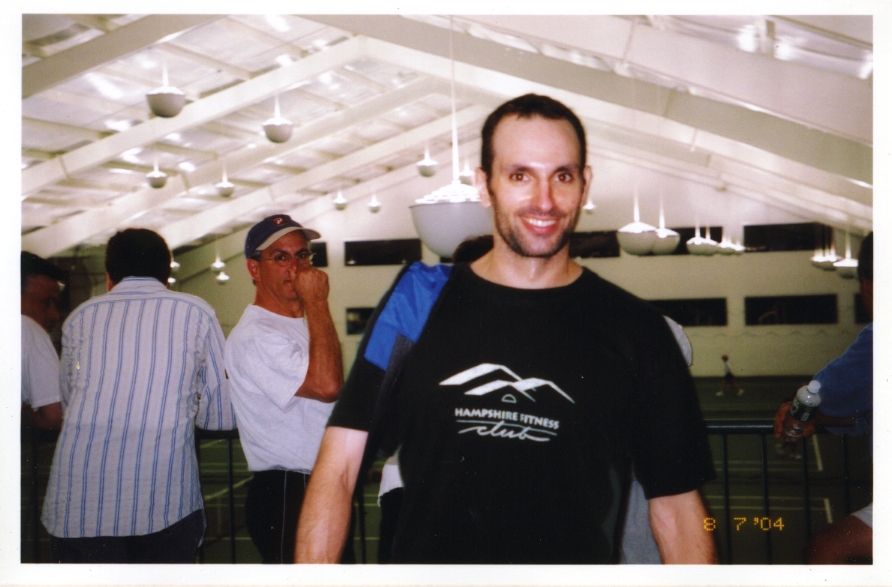
Immediately after upsetting one of the best players in the USTA Districts tournament, 2004

Immediately after upsetting one of the best players in the USTA Districts tournament, 2004


“I thought to myself, ‘Someday I will look back on this and laugh.’ When that day comes, I will let you know.”

In the summer of 2006, I rode my bicycle from Seattle to Boston for charity. One morning outside of Eureka, Montana, I fell off my bike and hurt myself. I wish I had a more exciting or heroic story to tell, but the truth is that I was not even moving at the time of my fall. In the process of mounting my bike, I lost my balance and started to lean to my left. As I tried to plant my left foot on the ground, my cleat accidentally glanced the pedal and clipped in. With no way to stop my momentum, I fell over to my left and landed on my back. Because I was wearing a backpack, my spine forcefully hyperextended upon impact. Although I did not know it at the time, I had fractured some bones in my spine near the surgical site.
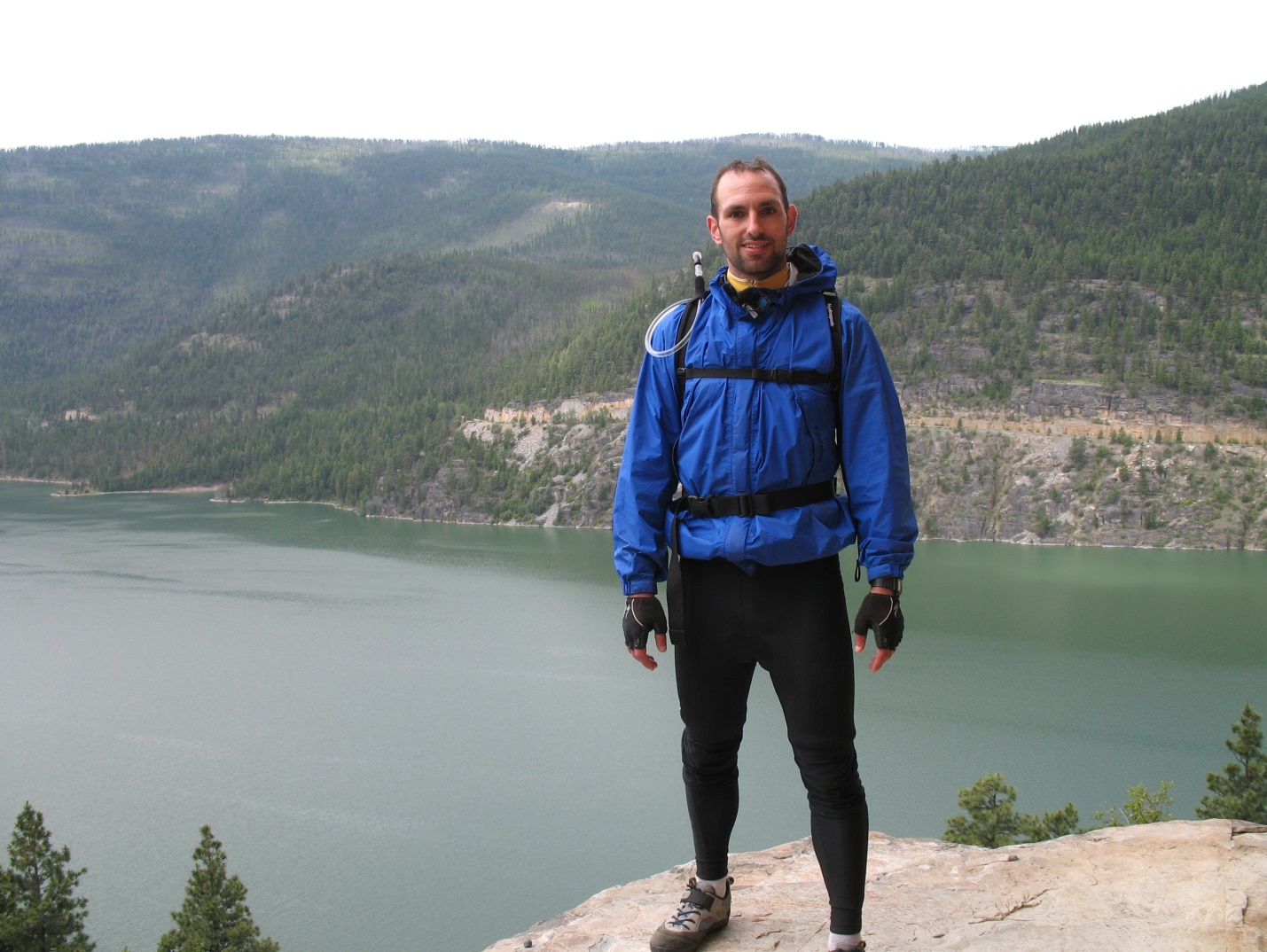
Standing over Lake Koocanua in Montana a few minutes before my accident, 2006

Standing over Lake Koocanusa in Montana a few minutes before my accident, 2006

In that moment, all I knew was that I was in a tremendous amount of pain and I was having trouble moving because the muscles in my back and hips had completely locked. Reaching Eureka, which was just a few miles down the road from where I fell, was a painful struggle. When I got into town, I found a gas station and went into their bathroom. Only after using the toilet did I realize there was no toilet paper, and my back was so bad that initially I was unable to stand up. There I was, injured, thousands of miles from home, stuck on the toilet, unable to wipe, unable to stand, and I thought to myself, “Someday I will look back on this and laugh.” When that day comes, I will let you know.

Although I managed to finish the trek back to Boston, my back was never quite the same again. When I got home and resumed playing tennis, I knew I was not right physically and my confidence on the court was gone. After starting the season 1-2, I went to the neurologist, then to a couple of surgeons, got the bad news about the fractures, and stopped playing. Because my appreciation for the sport had deepened since college, leaving the sport behind for a second time was even harder than the first time around. To date, I have not played competitive tennis in over seven years.


“Balance is the foundation of a healthy lifestyle. Sometimes it takes going through a period of imbalance to come out on the other side and find a happy medium between taking care of your health and taking care of who you are.”

Others have talked about the parallel between tennis and life much more eloquently than I can. Some mention the loneliness of a tennis player, but there is a harsh beauty about having sole responsibility for your actions. Everything you do right and wrong, every act of sportsmanship and gamesmanship, every sound strategy and dumb idea, every shot made under pressure and choked away, they are all yours. You own them all. Together, they comprise a bouquet that defines you as the player that you are.

Consequently, when you make a mistake, you have to face the fact that nobody else is to blame and accordingly use it as a learning opportunity to grow. Conversely, when you do set out to execute a shot or strategy and you make it a reality, there is a peaceful satisfaction, a sense of well-earned serenity, that comes with knowing that you made it happen. One of the best feelings in the world is launching a topspin lob over your opponent’s head, tracking the ball as it arcs through the air, and, out of the corner of your eye, noticing him turn his back and helplessly slump his shoulders as he discovers what you already knew from the the moment the ball left your strings: It is landing in.

At the same time, the ultimate outcome of a match is sometimes out of our hands. You can do everything in your power to win, dig as deep as you possibly can, and still lose. In this kind of defeat, you learn that there are incidents in life that are not up to us. We are only somewhat in control of our own destiny, and we have to roll with events and outcomes that do not go our way.

This lesson comes into play frequently in my work as a dietitian. Some people act as if they can avoid morbidity and mortality if only they get more strict with their food intakes and more rigid with their lifestyles. In other words, if only they take things up a notch, everything will be okay. It can be hard to accept that we will all die, our bodies are not designed to last forever, and if we are lucky enough to be spared fatal accidents and malicious acts, we will each eventually succumb to a condition of some sort. The truth is that we can minimize our chances of getting sick and dying prematurely, but it is a matter of risk reduction, not risk elimination.

Given our uncertain futures, we need to make sure we do not get so caught up in trying to take care of our health that we lose ourselves and the pleasurable aspects of life in the process. I learned this lesson the hard way in the years after my surgery. Balance is the foundation of a healthy lifestyle. Sometimes it takes going through a period of imbalance to come out on the other side and find a happy medium between taking care of your health and taking care of who you are.

My friend, Ben, who gave me tennis lessons when I was just starting to play, could tell you all about life’s unpredictability, but he eventually died of the tumor that kept him from playing the only season in which our high school careers overlapped. He was only 25 when he passed away 15 years ago. To this day, he remains the single nicest and most considerate person I have ever met. Sitting at his funeral, I felt not just sadness, but an overwhelming sense of unfairness: Not only was Ben cheated out of life, but life was cheated out of Ben. Despite the time that has gone by since Ben’s passing, I still think about him often and how much better I would be to everybody in my own life if only I could be at least a little bit more like him.


“Everybody belongs somewhere; everybody has a home.”

When my back suddenly and dramatically worsened this past fall, the idea of surgery was presented to me. Not only would an operation improve my pain, fix some of my spine’s structural issues, and increase my function, the surgeons said it could also allow me to return to competitive tennis. However, given how awful my first back surgery experience was, my resistance to a second surgery was strong. As rest, physical therapy, medications, injections, and acupuncture showed their inability to fix what is really a structural problem, I knew I had to give surgery more consideration.

In an attempt to work through my ambivalence, I sought opinions from six surgeons, discussed the dilemma with Joanne, and began to write this document. Whether trying out for a team that I thought I had no shot of making, sticking around after I had been cut or told to cut myself, or coming back (twice) after my first back surgery, I have always done whatever I could to stay in the game. The realization that ultimately enabled me to make my decision was discerning that choosing to undergo, not decline, surgery represents a continuation of this long-held personal mission. This turning point marked the resolution of my ambivalence. Today, the day of my surgery, my mission continues.

We are only hard-wired to an extent. If I was born into a different culture, perhaps I would have pursued cricket, or in a different time, jousting. Perhaps I could reinvent myself even now, maybe take up chess or painting or get more involved in music again. However, my efforts to refocus my life in the last seven years have done nothing to fill the hole, which feels just as deep now as it did upon its creation. Without tennis, I am not the same person. It has woven itself into my life’s fabric so tightly that it is part of how I self-identify. I am a tennis player. Everybody belongs somewhere; everybody has a home. I know where I belong, and I hope that with patience, hard work, and the tempered resolve to wake up each morning and inch one day closer, I can make it back there.


Casually hitting with my brother-in-law in Newport, 2012

He Said, She Said: New Year’s Resolutions

Posted on by

You already know that New Year’s resolutions do not typically last, but you have not yet heard our opinions as to why and what you can do about it.

He Said

A few weeks is not yet enough time for most New Year’s resolutions to have fallen apart, but if past statistics are any indication, by the end of the year only 8% of us will have been successful in achieving our resolutions.  The poor rate of conversion from resolution to reality is partly due to the goals themselves, as Joanne will discuss below, but being honest with ourselves about how ready we are for change is of utmost importance, too.

According to the Transtheoretical Model describing behavior change, individuals can fall into any one of five stages.  The preceding link gives detailed explanations of each stage, which I will concisely summarize below.

  • Precontemplation: The person does not see a problem and therefore has no intention of changing.
  • Contemplation: The person recognizes that a problem may exist but feels ambivalent about what to do.
  • Preparation: The person has decided to make changes and is formulating a plan.
  • Action: The person is implementing changes but has not yet maintained them for six months.
  • Maintenance: The person has maintained the given changes for six months or longer.  (Note: Some versions of the Transtheoretical Model also throw in an additional stage, Termination, but often this stage is considered part of the Maintenance stage.)

Classically, the idea is that a person moves from one stage to the next in the sequence in which I listed them, but in reality someone can jump from any one stage to another at any point in time.  The Model is not perfect, but it expresses an invaluable truth: Not everybody is ready to change.

This truth, by the way, is perfectly fine.  Change is a process, as the Model indicates.  When Joanne describes our counseling approach to people unfamiliar with how we work, she often tells them, “We meet our patients where they are.”  She does not mean that literally as if we make home visits; rather, she is referring to their stage of change.  Recognition of said stage is critical to successful counseling.

What do you think would happen if I counseled a patient on the changes he can make to his eating (thereby treating him as if he is in the Preparation stage) while he does not even see a problem with his diet and came to my office only because his doctor insisted he see a dietitian (which suggests he is in the Precontemplation stage)?  He would not feel heard, the session would be unproductive, in all likelihood he would not return for another session, and whatever health condition he is dealing with would remain a problem.

Conversely, if I listen to him without judgment as he shares his emotions and opinions, acknowledge the validity of his feelings and point of view, and discuss his doctor’s concerns with him, he may transition to the Contemplation stage and move closer to ultimately making and sustaining behavior changes that will improve his health.

Alternatively, perhaps after learning more about his condition and the potential consequences, he decides that he will maintain his current lifestyle anyway, at least for now.  It is his life, he can do what he wants with it, and I respect his choice without judgment.  At least he will have had an opportunity to weigh his options and make an informed decision.

Similarly, we each have to meet ourselves where we are at, too.  In other words, when we make New Year’s resolutions, we have to be honest with ourselves about how ready we are to make the given change happen.  The calendar’s flip from December to January does not automatically transition us to the Action stage.  In all likelihood, if we were truly in the Action stage, we would have implemented the change before New Year’s rather than wait for the holiday.  Willpower can only force change for so long.  Whatever was holding us back before New Year’s will remain and ultimately catch up to us after the holiday and bring an end to the resolution.

Instead of setting yourself up for failure by setting a goal that is unfit for your readiness to change, use the New Year as an opportunity to be honest with yourself about your health and how you feel about it.  In other words, meet yourself where you are instead of forcing yourself to take an action before you are truly ready for it.  Reach out for whatever information or support you need.  Consider the following examples:

  • A husband in the Precontemplation stage might give in to his wife’s urging to finally make an appointment with a dermatologist to have his strange-looking mole examined if for no other reason than to appease her.
  • Perhaps a diabetic in the Contemplation stage might decide to schedule an appointment with his doctor to discuss his ambivalence regarding monitoring his blood sugar at home.
  • An individual in the Preparation stage might meet with me to plan specific and achievable changes to his eating that will improve his cholesterol, then go home and discuss the upcoming changes with his family.
  • An osteoporosis patient in the Action stage might continue to use the package of personal training sessions she bought so she can continue learning how to lift weights safely and preserve her bone structure.

Most important, remember that New Year’s is just an arbitrary point, and one need not wait for a new calendar year to start the process of making change.  Said differently, we do not need an exterior cue to trigger internal change.  When we are truly ready, we will make the change happen no matter what date it is.  One of my favorite quotes is from Andre Agassi’s Hall of Fame induction: “ . . . every journey is epic, every journey is important, every journey begins today.”


She Said

Mid-January through the beginning of February is a tricky time for many of my patients.  Their motivation for keeping all of their nutrition resolutions is starting to dwindle, and many people feel like they have failed in one way or another.  What I often find is that many of my patients had set the bar too high in terms of nutrition goals.  They expect too much from themselves and have no other option than to not meet their goals.  Most of these goals are so overly ambitious that it would be very difficult for almost anyone to follow through with them.

So what’s a person to do?

When my patients ask me for help setting nutrition goals, I tell them to think S.M.A.R.T., as in goals that are Specific, Measurable, Attainable, Relevant, and Time-bound. No, I didn’t invent this clever mnemonic; it has been attributed to George T. Doran who wrote a paper called There’s a S.MA.R.T. way to write management’s goals and objectives in the November 1981 issue of Management Review.  But I really like the simplicity of this handy acronym.

Specific goals are those that are clear-cut and unambiguous.  Examples of specific goals could be “I will make a kale smoothie for breakfast…,” or “I will prepare a new salmon recipe…”  Measurable means that the goal must be quantifiable in some way so that you can clearly assess your progress.  This can be accomplished by adding to the above goals; for example, “I will make a kale smoothie for breakfast 2 times….” and “I will prepare a new salmon recipe one night….”

Attainable goals are those that are ones that realistic for you.  If, for instance, you know that making a kale smoothie for breakfast 5 mornings per week isn’t likely to happen (e.g., you often sleep late and don’t have time, you have difficulty going to the grocery store to get the ingredients, etc.), then shoot for something you absolutely know you can do.  In other words, it’s much better to start with smaller goals and then build on them than to start with goals that are too ambitious for you.

Relevant goals are ones that are worthwhile and applicable to you.  If upping your omega-3 intake isn’t that important to you, then don’t set a goal to eat more salmon.  By the same token, if you are already succeeding at one area of your nutrition (say, getting your leafy greens), then maybe it’s time to focus on something else, like increasing your nut intake.

Finally, it’s important that your goals are time-bound, that there is a particular time frame for achieving them.  You could add on to the examples given above: “I will make a kale smoothie for breakfast 2 times this week,” and “I will prepare a new salmon dish one night per week for two months.”  By giving yourself a deadline, you will be more likely to achieve your goal on or before that deadline.

If the above seems a bit much, the one piece of advice I give all of my patients is to keep it simple.  When goals are overly complicated and ambitious, it can be overwhelming.  And be kind to yourself – you are human, after all!