
Ed

Posted on by

Earlier today I found out that one of my former tennis partners, Ed, passed away. While I was at a conference (more on that in a future blog entry), a presenter made a comment that reminded me of Ed, so I took out my phone and googled his name thinking that perhaps I would find his Facebook page. Instead, I found his obituary.

When I was in the process of making my second of two comebacks following my initial back operation, Ed was one of a small handful of players who were gracious enough to help me integrate into the local tennis community. My game at that point was covered in rust and I would not have blamed Ed for distancing himself from me, but instead he invited me to become a regular in his twice-weekly games. He and I played doubles together on Wednesday and Sunday nights for years. No matter who won, we always had fun. Those nights comprise some of my favorite tennis memories.

Tennis aside, Ed had a greater influence on my life than he ever realized. In fact, I mentioned Ed in passing in a previous blog entry. Out of everybody I played tennis with, Ed was probably the skinniest. He also happened to be, at least to my knowledge, one of the sickest. He suffered a mild heart attack soon after we began playing together and I came to find out he was also diabetic. He later died of cancer.

Like many people in our society, I held a weight bias without even realizing it. How could a man so lean have diabetes and cardiovascular disease? Aren’t those conditions reserved for obese people? When Ed revealed his conditions to me, I had to reconsider the stereotypes I was holding, the first step of which was to acknowledge that they were, indeed, stereotypes.

My mind opened: Weight does not equal health. This notion has since been further compounded by many sources, including formal schooling, clinical experiences, research, and collaboration with colleagues.

But while many other influences came after him, Ed planted the seed, and I owe him a great deal of gratitude for that. Whenever I help someone shift away from weight stigma or I hit an unreturnable lob over my opponent’s head, I will be sure to remember Ed and say a quiet thanks for all that he taught me.
Something is better than “all or nothing”

Posted on by

Lately it seems like I have a number of patients who are struggling. Whether it’s sticking to their prescribed meal plan, trying to incorporate more fruits or veggies into their diet or eating more intuitively, many of them are just finding themselves at a loss. When they are stressed out due to life’s challenges, they revert to their old ways of coping. For some that might mean restricting their intake and counting calories obsessively, for others that might mean zoning out on the couch watching TV with a bag of chips. Oftentimes I will hear the same reasoning: “I just couldn’t do [healthy habit] this week; it felt like too much effort.”

When we dig deeper, I often find that many of my patients have an “all or nothing” mindset about their eating. Either they are 100% committed to making healthy eating choices or they throw their hands up and say “screw it!” It might look something like this: a patient who has stated a goal that she only wants to eat out at restaurants twice per week found herself overworked and stressed and ended up eating out five times during that week. Or perhaps someone has set a goal of meal planning and grocery shopping every Sunday, but he just never gets around to it.

A lot of the time, these patients will come in to our appointment with their heads held low and feeling like failures. This isn’t the case! I look at these “failures” as data that we can use to help us in the future. Maybe the goals that were set were too much for that person at the time. Or perhaps there is another area of change that we should focus on. The best thing we can do in our session is to rework the goals that aren’t being met. Sometimes that means making these goals a bit more achievable (e.g. aiming for eating out 4 or fewer times per week for someone who is used to eating out 5 or more times per week).

The other idea I think is important is the “good enough,” concept. No one is perfect and similarly, when we expect ourselves to never fail, we are setting ourselves up for failure. Sometimes achieving parts of our goals is better than totally giving up completely. For instance, let’s say someone is really struggling with eating healthy lunches during the week. She is buried under paperwork and totally overextended at work and has been just grabbing a bag of chips from the vending machine. Ideally, she’d like to be packing her home-cooked lunches the night before and bringing them with her to work every day. But, it just isn’t happening. How about working on a middle ground solution? That could be bringing frozen meals for lunch instead of either buying potato chips or bringing home-cooked lunches. Are frozen meals ideal? No. But are they “good enough,” i.e. better than nothing? Absolutely!

The above example might feel uncomfortable for many people. Oftentimes, a patient will come into our session feeling like they have been “bad” because she didn’t achieve the goals we set last session 100%. What I say to that is: 1) maybe we didn’t set the right goal and 2) all you can do is the best you can do in that moment. Even if you don’t fully reach all of your goals, try to ease up on yourself a bit and realize that you are human. Something is always better than “all or nothing.”

What is weight loss really about?

Posted on by

We know that the long-term success rate of weight-loss attempts is poor, yet patients often act like their reasons for wanting to lose weight are so justifiable that the odds should change just for them, as if I hold some magic solution that I keep secret and only break out when somebody gives me a really good reason to do so.

Attaining the ability to fly like a bird would sure make my life easier. No more getting stuck in traffic, spewing environmentally-harmful emissions, or spending money on gas, and perhaps I could save money on a gym membership since my physical activity would be built naturally into my daily commute. All good and valid reasons, but still the chances of me acquiring a superpower are probably not very high.

Whenever a patient tells me he or she wishes to lose weight I always ask why, but not so he or she can build a compelling case that somehow changes the dismal odds, but rather so we can find alternative paths to achieving the underlying goals.

If someone says, “I need to lose weight because I have hypertension (or high cholesterol, or high blood sugar, etc.)” I suggest we explore more effective ways of directly addressing those markers. One particular person comes to mind, a woman who had been dealing with high blood pressure and elevated cholesterol for most of her adult life, who had gone from diet to diet trying to finally achieve the long-term weight loss she had desired since her teen years. Ultimately, when she gave up that weight-centered model of care, and instead focused on improving her relationship with food and finding modes of physical activity that were enjoyable rather than punishing, both her cholesterol and blood pressure improved even as her weight actually increased.

One of my long-term patients talks about how he feels bad about himself and his appearance. He is afraid to take off his shirt at the beach for fear that he will disgust other people and himself. In my experiences, patients who link their weight to how they feel about themselves only sometimes feel better when the weight drops. Oftentimes, someone reaches his or her goal weight and then expresses a desire to lose more because the negative feelings did not dissipate with the weight lost to date.

The weight is really not the issue, but rather just the vehicle through which emotional complexities are playing out. Even for those who do feel better about themselves when the weight drops, we know that almost all weight loss is only temporary so what happens when the weight comes back? Although this particular patient does not feel ready to go yet, I have been gently encouraging him to see a therapist to work on his body image and self-esteem. For his sake, I hope that someday he learns that one need not have a certain body shape or size to feel good about oneself.

Earlier this year, a man came to me saying he wanted to lose weight in order to complete a marathon. I explained that if he chose to continue working with me, I would help him change his eating to run his best, and as a result of said eating changes he may or may not experience a change in his weight, but that I would not be directly helping him to lose weight. Skeptical, he made some condescending and rude remarks, left, and never returned. Weight and running performance are not synonymous. In fact, I ran my fastest marathon when I was at my heaviest. If someone wants to improve sports performance, then let us focus directly on that and put issues of weight aside.

Our reasons for wanting to lose weight and the importance of said reasons do not dramatically impact our ability to achieve it, but by looking deeper at our motivations to lose weight, we can move beyond focusing on weight and more effectively target the underlying goals. For example, I may never attain the ability to fly, but you know what I could do that would satisfy all of my reasons for wanting to do so? Ride my bike.

“Weight that will stay off”

Posted on by

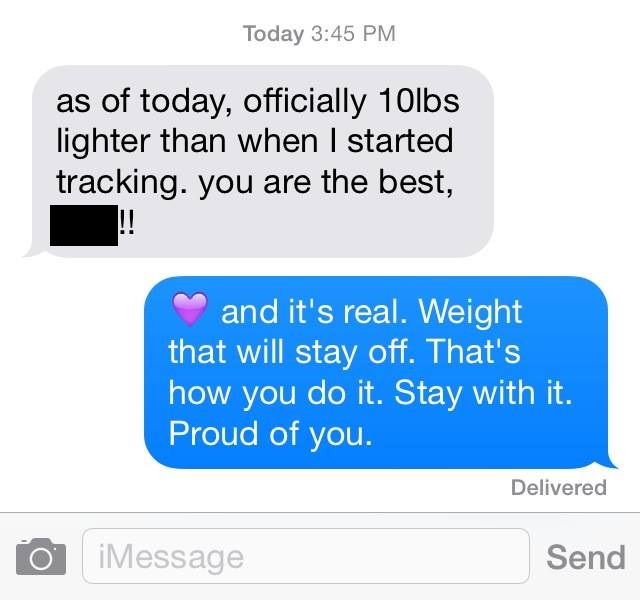
TextThe above text exchange appeared in my Facebook feed, placed there by a personal trainer (whose name I blacked out from the image) who shared it to promote his business, a testimony to his prowess and the results he can bring to his clients who are seeking to lose weight.

Let’s talk about results. Losing weight is relatively easy and numerous paths to weight loss exist. Keeping off the lost weight, well, that is a completely different story. Research shows us that about 95% of people who try to lose weight will ultimately regain it (whether or not they maintain the behaviors that created the weight loss in the first place) and of that 95%, 60% of them will end up heavier than they were at baseline.

Said differently, if 100 people intentionally lose weight, five of them will keep it off, 38 of them will return to baseline, and 57 of them will end up heavier than when they started.

These facts may not be talked about very much in our weight-loss-obsessed society, but they are no secret. At the 2013 Cardiometabolic Health Congress, data were presented showing that this pattern of weight loss and subsequent regain was virtually identical regardless of the mode somebody used to lose it. That is why some people in the healthcare field say that the best way to gain weight is to go on a diet.

So when the trainer refers to his client’s 10 pounds of lost weight as “Weight that will stay off,” on what is he basing that claim? Based on the research, if he says something like that to 20 of his clients, 19 times he will be wrong. Not only is he misleading people with false promises and expectations, but he is putting them at high risk for weight cycling and the negative consequences with which it is associated.

Chances are better than not that the client in question will eventually regain the 10 pounds he or she lost plus more. What will the text exchange between the trainer and client look like then?

The sad thing is that I think the trainer in question is actually a good trainer in terms of the mechanics of his profession. He just needs to be more careful about the lessons he is teaching his clients. Had he responded to his client’s text with a sentiment along the lines of, “Losing weight feels important to you right now, but let’s remember that being physically active is doing wonders for your health and well-being regardless of what happens with your weight,” I would not be writing this blog.

Day 197: Control

Posted on by

“It’s hard to keep things fresh and not become a parody of yourself. And if you’ve ever seen that movie Spinal Tap, you’ll know how easy it is. It’s a parody of what we all do. The first time I ever saw it, I didn’t laugh. I wept. I wept because I recognized so much in so many of those scenes. I don’t think I’m alone amongst all of us here in that.”

– The Edge, U2’s Rock and Roll Hall of Fame Induction, 2005


To be fair, Grey’s Anatomy is probably not the worst show on television, but the overly-dramatized plots and scenes that are supposed to make me laugh but do nothing of the sort leave me wondering what so many other people see in the show. Its long run of prime-time success seems to indicate that my opinion is that of the minority.

Above my other criticisms, the aspect of the show that rubs me the wrong way is how themes in patient care just so happen to mimic whatever events are going on in the doctors’ personal lives. Every episode this occurs. My eyes roll. As if someone is telling me the same joke over and over again, I want to interrupt and plead: Stop, please, I get it already.

Then to my horror, I realize the joke is on me: They’re right. The themes running through patient care and my own life really do seem to happen with such regularity.

In the midst of a late-summer walk, the inspiration hit me to try jogging for the first time since my surgery. I broke out into a jog and slowly shuffled along before the pain in my back was so intense that I had to slow down and resume my walking. Maybe I had jogged 20 yards, roughly the equivalent of crossing a wide street. This occurred in early August. According to surgeons’ predictions, I should have been able to start running in June.

In both life and healthcare, only some factors are in our control. The rest of them? Who knows. That is why I am so careful about tying goals to specific outcomes that are only somewhat under our influence. Furthermore, it is why I am wary of predicting how my patients will fare in terms of weight, cholesterol, blood pressure, or whatever other outcomes they are attempting to influence.

One of the most influential lessons in my life happened in the span of a few seconds in the south Pacific. As I sat on the boat’s edge preparing to snorkel at the Great Barrier Reef, a wave came up and dragged me into the water. There is power, and then there is power. Mine was dwarfed by that of the ocean, which had its way with me. While I struggled to get back to the boat as the water pushed and pulled me with much greater force than I anticipated, I had an epiphany of humility: We do not have as much control over our lives as we would like to think.

Having only limited control does not mean we should throw up our hands and give up. It just means we need to keep perspective, accept our limited power as we continue our work, temper expectations, and adjust to whatever comes.

After five months of waiting, I was finally cleared to begin physical therapy in late August. With the help of my therapist, I am working hard to reclaim my conditioning and put myself in the best possible position for my desired outcome: a return to competitive running and tennis. Neither sport is a possibility right now, even though I had expected to be able to resume both activities months ago. Given that, I have refocused my efforts on outdoor cycling.

Getting on my bike again was fantastic. Riding produces no pain whatsoever. Although my cardiovascular fitness has plummeted due inactivity and I am not able to ride as far now as I used to, just going through the routine of prepping my bike, putting on my helmet, starting my bike computer, and setting off down the road is the closest to the old me I have felt in just about a year. It makes me feel, well, normal.

We only have so much control over what happens and when, but if we keep our expectations in check and adapt accordingly, we can still find ways to thrive. I’m sure there must be a Grey’s Anatomy episode about that.


What to Eat Before/After Exercise?

Posted on by

We are always looking for suggestions for blog entry topics. This morning, a colleague messaged us on our Facebook page and asked us to write a piece on nutrition for student athletes. More specifically, she asked us to write about what a student-athlete should eat before and after a demanding workout.

Like most areas of nutrition, sports nutrition must be individualized. In other words, what works for your friend, teammate, brother, sister, etc. will not necessarily have you performing your best and vice versa, nor will the guidelines I outline below automatically work for you either. For that reason, I always suggest trying out a new eating routine on a practice day. Competition days are not for experimenting, but rather for eating the foods that you know from experience will have you performing up to the best of your capabilities.

In addition to individuality, other factors influence what and when we eat before exercise. Our main source of fuel during exercise is carbohydrates. Because of that, we want them to be the bulk of our intake before our workout. Their form, quantity, and combination with other foods depend on the intensity, duration, and mode of the upcoming workout.

Before a high-intensity bout of exercise, such as a cross-country race, we often need a greater amount of digestion time and a higher ratio of carbohydrates. For example, the student-athlete might have a plate of pasta with a small portion of grilled chicken at lunch in preparation for an afternoon race. If the athlete had the meal closer to race time, he or she may wish to ditch the chicken and have just the pasta, which will be more quickly absorbed in absence of the meat. Yogurt or toast with jam are other examples of small pre-exercise meals that work for some people. Someone who likes to fuel very closely to a high-intensity event might do better with a small amount of fruit or liquid nutrition, like Gatorade. Fruit juice is not ideal during this time; the high fructose content can cause gastrointestinal distress.

Before a low-intensity event, such as a long-distance bike ride or a game of baseball, people can often tolerate more well-rounded meals closer to exercise. Carbohydrate content should still be high, but more protein and fat can often be tolerated. Presence of the latter two macronutrients can also be helpful by slowing digestion and delaying the onset of hunger. Waffles with peanut butter, a burrito, or my previous example of pasta with chicken are examples of meals that can work well before an event of this caliber.

After exercise, our attention shifts from fueling to recovering. We have a short window of time (approximately 30-60 minutes) following exercise in which enzymatic activity is elevated and enables our bodies to be especially good at repairing muscles and replenishing glycogen stores during this time. For that reason, soon after exercise we want to consume both protein and carbohydrates. Examples include a small turkey sandwich, an apple with peanut butter, or yogurt.

Student-athletes often find themselves having to deal with a gap of time between finishing practice and when the family sits down to dinner, so having a post-practice snack that incorporates both protein and carbohydrates is going to be especially important. Taking advantage of this short window of time often necessitates bringing shelf-stable food that can tolerate being unrefrigerated from the time the student leaves home early in the morning to the afternoon after practice. Nuts, in combination with a carbohydrate source, such as fresh or dried fruit, often work well. Shelf-stable boxed milk or a product like Orgain, which is essentially protein-fortified milk, can also do the job.

Heavy sweaters and people who tend to lose a high amount of salt in their sweat (i.e. someone who leaves white streaks of salt deposits in exercise clothing) also need to focus on replenishing sodium. Gatorade Endurance or salted nuts, pretzels, popcorn, or tortilla chips are good options.

If you are a student-athlete and you would like individualized help with fueling yourself to perform your best, come see one of us or another registered dietitian who has expertise in sports nutrition.

Weight Loss Specialist

Posted on by

“Luck is the last dying wish of those who want to believe that winning can happen by accident. Sweat is for those who know it’s a choice.”

Suggesting that achieving our goals is up to us if only we work hard enough sounds motivating on the surface, but really it makes no sense. So, what, the 99.2% of players in the U.S. Open main draws who walked away without a title did not realize all they had to do was work hard and choose to win? Outcomes that rely on factors beyond our control breaking our way are not automatically there for the taking if only we put our mind to it.

Where that quote originally comes from is not clear to me, but I know I first heard it from a personal trainer who cites it as one of his favorite quotes. According to said trainer’s Facebook page, he now employs a certified “Weight Loss Specialist.” Awesome.

Here is the problem: If a supposed specialist is giving you the information you supposedly need to lose weight, and achieving your goal is framed as a choice that is entirely in your control and can be attained through hard work, and you do not achieve your weight-loss goal, then who is to blame?

You.

If we mislead people into believing that weight loss is entirely up to them and they do not achieve (or more likely maintain) it, they typically turn their frustration and disappointment on themselves with berating thoughts like, “I have no willpower,” “I need to be more disciplined,” “I’m such a loser,” and “I just need to work harder next time.”

Behaviors that in and of themselves were beneficial to health independent of weight loss, such as being physically active or eating fruits and vegetables, are abandoned because they did not lead to weight loss. Restriction gets taken up a notch. They pursue an even more rigid diet and/or intense exercise regimen, not realizing that these behaviors themselves can make weight increase and/or lead to health issues. A colleague of mine calls it “paradigm blindness.” In other words, many people do not realize that their presumed solution to being “overweight” actually exacerbates the condition, so they keep adding more of the supposed solution to the ever-worsening issue.

I used to help (and I use that verb loosely, as I was actually part of the problem even as I thought I was part of the solution) people with weight loss earlier in my career too, but that was before I knew better.

Well-constructed research, my clinical experience, and the experiences of many of my fellow dietitians teach us that weight loss is typically not in one’s control. Sure, our behaviors do matter, but other factors, such as genetics, environment, medical conditions, and personal history, are either partially or completely out of our hands.

The paradox is that any true “Weight Loss Specialist” would know that nobody by that title actually exists. Healthcare practitioners are supposed to help people with, you know, health, which is why Joanne and I take the focus off of weight and instead focus on behaviors that can actually make a difference.

Obesity Cuts Life Expectancy, Santa Is Responsible for Your Christmas Presents, and Other Misleading Statements

Posted on by

My interest in writing a blog right now is pretty much nil, but I cannot let today’s misleading boston.com article entitled “Obesity Cuts Life Expectancy by Up to 14 Years, Study Shows” go by without reacting, for I know the damage that pieces like this do to people, including some of my patients.

Long story short: The researchers who authored the primary source article did not adequately control for behaviors. They screened out potential participants who had ever smoked and/or had a history of certain diseases, but the lifestyle behavior information they collected from participants was limited to alcohol use and physical activity level. Researchers collected no information about other lifestyle factors, like stress management and eating and sleeping habits, all of which can impact health. The behavioral data they did collect was self reported, which introduces all sorts of error. Other research has shown that when behaviors are controlled for, body weight does not seem to matter, but the study design that these authors used prohibited any opportunity from being able to confirm or refute those findings.

The boston.com piece discusses a second article as well that examined the relationship between obesity and exercise. In reference to this latter article, the boston.com piece’s subheading concludes with, “And it’s under-exercise, not overeating, that’s causing America’s [obesity] epidemic.” That eye-catching text will certainly garner many clicks, which is unfortunate because it is not true. The actual research piece reads, “The research highlights the correlation between obesity and sedentary lifestyles, but because it is an observational study, it does not address the possible causal link between inactivity and weight gain.”

I cannot stress it enough: Correlation is not causation. They are entirely different. I know, I know, we each know somebody who has put on weight after they stopped working out. Sure, that does happen sometimes, but on the macroscopic level that is the population, the picture is much more complex than that with many other factors in play.

The boston.com article’s final paragraph begins with, “Losing weight is proven to significantly reverse the health effects of obesity.” Wrong. When we adapt healthier lifestyle behaviors, our body weight might change as well, but if we credit the weight change instead of the behavior change then we have it backwards.

The harm in all of this is that it reinforces a weight-centered model of eating and physical activity that ultimately fails nearly everybody who uses it. If we take a weight-centered approach and do not maintain the weight we want, we risk losing motivation and reverting to old behaviors because the goal was unattainable.

There is a better way. In the health-centered model that we advocate, the behaviors in and of themselves matter independent of weight. Whether weight goes up, down, or stays the same is irrelevant because the behaviors themselves are what count. Better-designed research seems to support this model: When we control for behaviors, health and weight look to be independent.

Physical Activity: So Much More Than Burning Calories

Posted on by

“Just finished a seven-mile run – definitely earned the right to splurge at the party tonight!”

“I play tennis six times per week to keep my weight in check and to be able to eat what I want.”

“Just gorged at my friend’s Fourth of July cookout – looks like I will need to hit the gym extra hard to burn all those calories off!”

The above are just some of the comments I have either seen posted on Facebook or heard in conversation over the past few weeks. While these types of comments are quite common and universally agreed upon, I have a problem with them for a few reasons.

There is an abundance of evidence that exercise improves one’s health. It not only has been proven to improve blood pressure, blood lipid profiles, inflammation, and heart health in general, it has also been found to help the processing of glucose and insulin as well. But despite all of these positive findings, there is very little scientific evidence that exercise is an effective way to control weight and that exercise by itself does not have as much of an impact on our metabolism as most people think it does.

In one study, a group of volunteers from a hunting and gathering tribe in Tanzania were studied to see if there was a link between their activity levels and the number of calories they burned in a day. While it was true that the tribe members were much more active than the average American, walking about 7 miles per day on average, their metabolic rates were about the same as the average metabolic rate for Westerners. That means that despite the fact that the tribe members were doing significantly more physical activity than Westerners, they were burning the same number of calories as Westerners. Their increased activity did not mean they burned more calories.

Aside from the problematic idea about using exercise as a weight control mechanism, the bigger problem I have is the common belief that exercise’s only benefit is to burn calories. I know so many people who run regularly, not because they love to run, but rather because they are repenting for their dietary “sins.” Whatever happened to being physically active because we enjoy the way it makes us feel? Whatever happened to playing a friendly game of pick-up basketball for the sheer fun of it? Or jumping into the pool on a hot summer day to cool off and splash around? So many of us view exercise as a way to punish our bodies into submission rather than as a way to feel more alive and appreciate what our bodies can do.

How about we start using physical activity as a way to connect with our bodies and enjoy what they can do for us? How about engaging in exercise as a way to improve our health and help our bodies to function at their best? Or taking up a sport for the thrill of the game? The benefits of physical activity are so much more than simply burning off last night’s nachos. And no one needs to “earn” the right to eat what he or she wants. That is no way to live life.

Day 91: Progress (or Lack Thereof)

Posted on by

Today was supposed to be my day. Circled on my calendar back in March, today was my three-month CT scan and appointment with my surgeon. Although full recovery from a surgery of this magnitude takes right around a year, three months is considered enough time for sufficient healing to take place that allows for a return to normal activities. My expectation was that I would come home from the appointment and go right out for a run, my first in nine months.

As it turns out, I will not be running anytime soon. The surgeon used bone grafts to build two columns in my lower back. The CT scan showed that the column on the right is healing as expected, while the column on the left is far behind schedule. The chunks of bone that he implanted on the left are still sitting there independently with only minimal growth around them.

The surgeon said this is highly unusual. Typically, people either heal well bilaterally, or they heal poorly bilaterally, but two different progressions simultaneously is rare. He has no explanation as to what happened. He tells me that on paper I am the ideal candidate to heal well: young, active, non-smoker, healthy eating habits, etc. “On paper,” therefore, seems to be the key term.

Instead of today being my last appointment with him, now I have plans to see him again in mid-August, at which time I will undergo more tests to check how the bone is healing. Perhaps the fusions will progress between now and then, or perhaps they will not.

In the meantime, I am feeling very discouraged and disappointed. There will be no bike rides this summer. My planned return to competitive running on the one-year anniversary of my last race is out the window. So much for playing ping pong with my nephews when they visit over Independence Day weekend. I will not be able to help pack, unpack, and set up our first house when Joanne and I move later this summer. When I pan across the horizon of my life, tennis is nowhere to be seen.

Instead, I have two months ahead of more of the same. Three months ago, I thought June 18th would never come. In reality, the time passed just as slowly as I anticipated it would. To think I was done and then find out I have to do it almost all over again, but with more uncertainty and less optimism this time, is quite disheartening.

The other day, a new patient came to me frustrated that his efforts to lose weight have gone nowhere. When I suggested that we try a different approach by focusing on making healthy choices, learning to love and accept himself regardless of his size, and letting his weight settle wherever it naturally belongs, well, he did not want to hear that one bit.

He looked down at my lean frame and explained to me that I do not know what it is like to be judged on appearance, that I do not know what it is like to feel uncomfortable in my own body, that I do not know how frustrating it is for my body to not respond the way I would like despite my best efforts, and that I do understand the apparent unfairness of seeing somebody with an attribute or an ability that I covet, but cannot attain, for myself. Yeah, clearly I cannot relate to any of those themes at all.

Everybody is dealing with something, and while the particulars are unique to each person, common ground exists underneath. No matter what our goals are, if we do the best we can to achieve them and we still fall short, then by definition there is nothing more for us to do except adapt and find a new way to thrive. When I wrote, “In this kind of defeat, you learn that there are incidents in life that are not up to us. We are only somewhat in control of our own destiny, and we have to roll with events and outcomes that do not go our way,” I feared that perhaps I was foreshadowing my own outcome.

Maybe that will prove to indeed be the case. However, I am not going to use that as an excuse to keep from doing everything I can, while still maintaining perspective, to meet my goals. Today sucked, but my bitching is over. It’s time to get back to work.