Cut it Out?!

Posted on by

For as long as I can remember, the “experts” have been telling us to cut down on our sugar and fat intake in order to be healthy.  On the government’s “MyPlate,” the latest version of the healthy food pyramid, there are plate sections for fruits, vegetables, grains, protein, and dairy, but nowhere is there any plate section for sugar or fat.  In fact, if you go to the MyPlate website, the only place you can find sugar is under the “Empty Calories” heading.  And while fats (or oils) are listed under the “Food Groups Overview,” they do not make an appearance on, or anywhere near, the plate.

So, is anyone truly able to cut out both sugar and fat?  Well, it seems like it’s a lot harder than it sounds.  A recently-published review in the journal Critical Reviews in Food Science and Nutrition looked at 53 scientific papers and found that people who follow a diet low in sugar also had a significantly higher percentage of calories coming from fat, and low-fat dieters had a significantly higher percentage of calories coming from sugar.  This phenomenon, which many nutritionists have dubbed the “sugar-fat seesaw,” seems to occur because most sources of sugars, such as fruit, grains, and juices, are low in fat, while most sources of fat, like butter, oils and meat, are low in sugar.

So, what is the average health-conscious person supposed to do about this?  Well, instead of trying to cut out one major nutrient, how about trying a more moderate approach?  How about focusing on eating a healthy, balanced diet that includes all of the nutrients and not branding specific nutrients as either virtuous or evil?  Sugar and fat have a place in our healthy, balanced diets, and they should definitely be represented somewhere on MyPlate.

The Importance of Racing Strategy

Posted on by

Independence Day is a popular occasion for road races.  I love events like this that draw the community together, as runners/walkers of all abilities turn out to participate and others line the courses to cheer on the athletes.  As great as these events are, they are that much more fun and rewarding when we perform our best.

Putting ourselves in the best position for a great race requires more than proper nutrition and hard work.  We need sound strategy, both during training as well as on race day itself.   To illustrate my point, let me share with you the planning that went into my 2011 Mount Washington Road Race performance.

The Mount Washington Road Race involves running up the 7.6-mile auto road from the mountain’s base to the summit.  The mistake I made when I ran the race in previous years was trying to keep my pace per mile consistent throughout the event.   On some courses, such as one that is perfectly flat, this strategy might make sense.  On this particular course though where the grade changes and the air gets thinner father up the mountain, it made little sense for me to act as if every mile was the same.  Going into the 2011 race, I needed a new strategy that incorporated these variables.

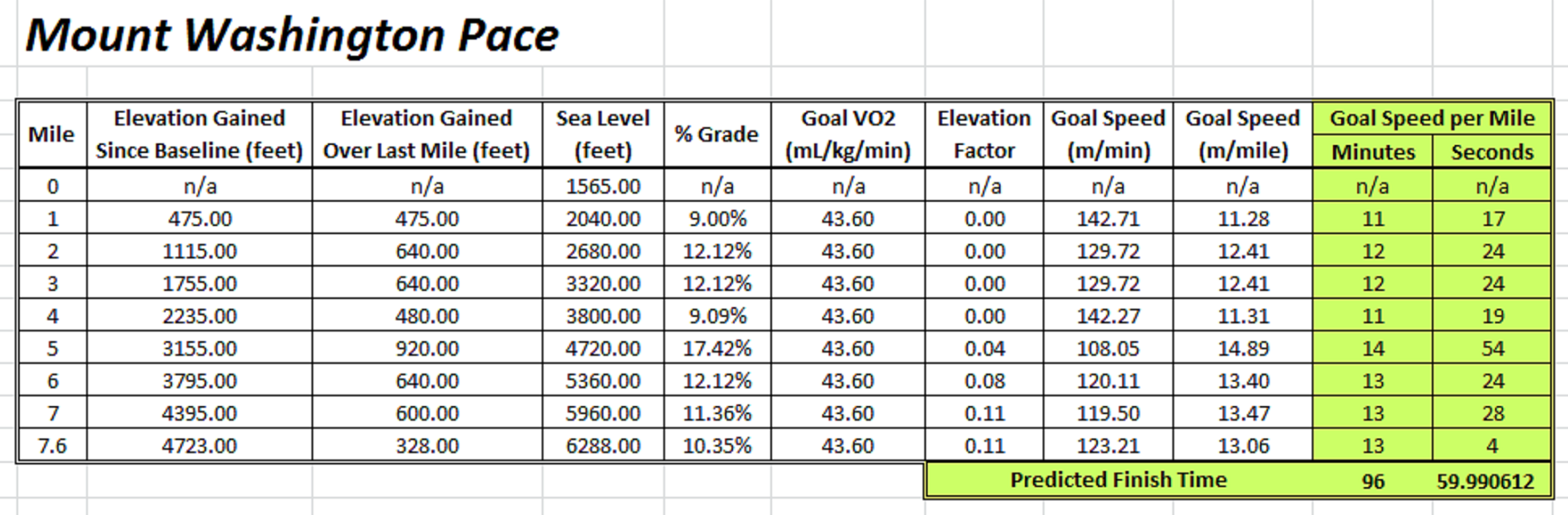
My new strategy was to keep my level of exertion consistent as the course conditions changed around me.  Using equations that take into account slope, speed, and altitude, I created a spreadsheet that determined the level of oxygen consumption (VO2) that I needed to maintain throughout the race in order to finish in my goal time.  The spreadsheet showed that I needed to maintain a VO2 of 43.6 mL/kg/minute for the entire event in order to finish in my goal time of 1:37.

MountWashingtonSpreadhseet

The next step was to convert 43.6 mL/kg/minute to METS, another measure of oxygen consumption.  The advantage of working with METS as opposed to VO2 is that METS appear on the digital displays of many treadmills, exercise bikes, and other cardiovascular equipment.  By using these pieces of training equipment at my desired METS level, I learned what it felt like in terms of perceived exertion to sustain that level of oxygen consumption.  I could then run outside at that same exertion level and be reasonably certain that I was running at the necessary VO2/METS level.

As my training continued across various modes, I built my endurance at this level of oxygen consumption until I could sustain it for close to the time I expected it would take me to finish the race.

The spreadsheet was not only helpful during training, but also the race itself, as it showed me what my time for each mile should be in order to finish within my goal time.  I wrote these times on the back of my left hand so I could easily compare them to my watch at each mile marker during the event.
MountWashingtonHand

I finished the 2011 race faster than I had in either of my previous two Mount Washington races.  I was not necessarily any fitter than I was in 2009 or 2010, but I was definitely smarter, and that made all the difference.

No matter the event for which you are training, make sure you have a sound plan in place that will get you to your goal.

He Said, She Said: Organic vs. Conventional

Posted on by

We often field questions from patients regarding which is better, organic or conventional produce, especially this time of year when people are visiting farmers’ markets and pick-your-own farms, growing their own gardens, and generally enjoying the abundance of different fruits and vegetables that are in season.

He Said

Would you rather pay less for your produce now and risk discovering later that conventional food is actually harmful, or pay more now for organic and risk finding out later that conventional would have been totally safe all along?

In other words, whether you choose to buy conventional or organic, you are taking a gamble either way. The decision is personal and based on your own concerns and priorities.

The middle ground between the poles is also a perfectly valid option. For those looking to pick their spots, the Environmental Working Group is a helpful resource. They publish a guide to help shoppers determine which fruits and vegetables they consider most important to buy organic based on pesticide contamination.

When it comes to organic vs. conventional produce, there really is no one right answer for everybody. As long as you are eating fruits and vegetables, you are making the right choice.

She Said

While in general I try to buy mostly organic fruits and vegetables, I am not obsessive about it. Yes, there are good reasons to buy organic (no pesticides, chemicals, hormones or genetically modified organisms (GMOs)), but there are a lot of myths out there about why organic foods are superior to conventional foods.

Although many people believe that organic produce is more nutritious than conventional, numerous studies have shown that there often is no difference in nutrient content between the two. What really seems to matter is how long the produce sits on the shelf, as more nutrients are lost when produce sits out for longer periods of time.

While it is true that organic produce is grown without pesticides or chemicals, it is not necessarily better for the environment than conventional produce, as conventional farming is more productive and efficient than organic farming. According to the Hudson Institute’s Center for Global Food Issues, if we were to switch all conventional farming to organic, we would need to cut down 10 million square miles of forest.

Finally, just because organic produce is chemical free does not mean you don’t have to be careful about washing it. It is still susceptible to bacteria.

So, while I don’t think there is anything wrong with choosing organic more often (It’s good to reduce our exposure to chemicals and pesticides.), it is important to know that organic is not inherently better than conventional.

Super Seeds!

Posted on by

Lately, a lot of my patients have been coming in with questions about seeds: What kind should they eat?  How much?  What are the benefits?  I thought it might be a good idea to come up with a little seed cheat sheet (say that 10 times fast!) to break it down and help my patients figure out what seeds (if any) would be best for them.

Flaxseeds

One of the most popular seeds around these days, flaxseeds are famous for being nutrient powerhouses. They are rich in B vitamins, magnesium, omega-3 fatty acids, fiber, and antioxidants. B vitamins and magnesium are essential for cell metabolism. Omega-3 fatty acids play an important role in reducing inflammation in the body. Flax has both soluble and insoluble fiber, which have been shown to help lower total cholesterol, stabilize blood sugar, and promote intestinal function. Antioxidants help to protect our cells from damaging free radicals that can occur from exposure to certain chemicals, radiation, pollution, and smoking.  

2 tablespoons of ground flaxseed contains 4 grams of fiber, 2.4 grams of the omega-3 fatty acid alpha-linolenic acid (ALA), and 300 milligrams of lignans (an antioxidant).  It’s important to grind flaxseeds into flaxseed meal before eating them to ensure that you will get all of these nutrients. Flaxseed can be added to almost anything to get its benefits – cereal, oatmeal, smoothies, or even into baked goods.

Hemp Seeds

Hemp seeds are very versatile.  They can be eaten raw, sprouted, ground into a meal, made into milk, steeped like a tea, or used in baking.  Like flaxseeds, hemp seeds are a good source of ALA and fiber. They are also one of the few plant sources that are considered a “complete” protein, meaning that it contains all 21 known amino acids (building blocks of protein), including the 9 “essential” ones that cannot be produced by the human body, making it a helpful addition for those who follow a vegetarian or vegan diet.

2 tablespoons of hemp seeds contains 882 milligrams of ALA, 2 grams of fiber, and 5 grams of protein. Hemp seeds can be eaten whole or shelled. Add them to your salad for some extra crunch!

Chia Seeds

While they might be the new seed on the block to many North Americans, chia seeds are native to South America and have been a staple of the Mayan and Aztec diets for centuries.  Like flaxseeds and hemp, chia is a good source of antioxidants.  Due to their high antioxidant content, they have a long shelf life, and they can last nearly 2 years without refrigeration. Chia is an excellent source of fiber, with 10 grams in just 2 tablespoons. It also boasts an impressive amount of calcium (18% of the Daily Recommended Intake), phosphorous, magnesium, and manganese, nutrients that are important for cell metabolism, preventing hypertension, and maintaining a healthy weight. Unlike flaxseeds, chia seeds can be digested whole and do not need to be ground to get their nutrition benefits. Interestingly, chia seeds can be used as an egg replacement: the outer layer of the seeds swells when mixed with liquid, causing it to form a gel. This gel can be used in place of eggs (for those who are vegan) in baked goods. To make the egg replacement, mix 1 tablespoon of chia seeds with 3 tablespoons of water and let sit for 15 minutes.

He Said, She Said: Health at Every Size®

Posted on by

Over the last several months, we have been learning more about the Health at Every Size® (HAES®) movement. The HAES® approach to health emphasizes eating intuitively and being physically active for pleasure rather than focusing on weight loss and dieting.

Clearly, the HAES® approach flies in the face of almost everything our society believes about health (i.e., that thin people are innately healthier than heavier people, and that losing weight is the be-all and end-all to being a healthier, happier person). Given the years and years of messages we have received about how dangerous it is to be overweight, the HAES® approach is a pretty revolutionary and scary premise.

He Said

The HAES® approach is most typically brought up in the context of overweight individuals, but health – or lack thereof – at leaner sizes also falls under the topic’s umbrella. In other words, just because someone is thin does not mean he or she is healthy.

Recently, a new patient was talking with me about the pressure she feels to be skinny in her community where so many of the women she sees around town are thin. While some of the women my patient envies no doubt are blessed with a foundation of helpful genetics on top of which they have built healthy lifestyles, some of them keep their figures through unhealthy means: excessive exercise, disordered eating, laxative abuse, anorexia, purging, etc.

The truth is that so many of us are dealing with health conditions invisible to others, such as diabetes, hypertension, depression, arthritis, Celiac disease, eating disorders, HIV, and high cholesterol, just to name a few, that we can judge neither one’s health nor lifestyle based on his or her size alone with any degree of accuracy.

She Said

I find a number of things about the HAES® approach interesting. The aspect I like the most is that it stresses that health is much more than just how much you weigh.

In a previous blog, I discussed the limitations of the BMI, as it does not give us enough information about an individual to determine his or her overall health. the HAES® approach says that health is about eating according to your body’s hunger, fullness, and appetite cues; exercising for pleasure (as opposed to doing so just to burn calories); and recognizing that health comes in all shapes and sizes.

These ideas are things that I try to stress in my sessions with clients – that if you are only focused on calories in vs. calories out, weight, and exercise solely for the purpose of weight loss, you are missing the bigger picture.

Chris Christie: Role Model or Cautionary Tale?

Posted on by

Earlier this week, Governor Chris Christie, who has been lambasted for his weight for years, announced that he underwent “secret” gastric band surgery in February.  In an interview with NBC Rock Center’s Brian Williams, Christie said that after turning 50 last fall, he began to reflect on his life and realized that he wanted to get his weight “under control” so that he could be healthier for his wife and children.  His weight-loss doctor likened Christie’s obesity to having cancer, asking Christie, “If you came in here with cancer and I told you that I had a 40-minute surgery that’d give you a 90 percent chance of cure, would you sign up?”  Of course, Christie answered in the affirmative.

Lap-band surgery, in which an inflatable silicone device is placed around the top portion of the stomach to slow the consumption of food, is not the “cure” that Christie’s doctor says it is.  For nearly half of the patients who have the surgery, the devices need to be removed due to erosion or other malfunctions.  While most patients lose between 48 and 99 pounds in the first year after having the procedure, a number of studies have shown that the procedure is not successful over the long-term, resulting in sub-optimal weight loss and increase in failure rates.  One of those studies saw a 36.9% failure rate (defined as an excess weight loss of <25% or major reoperation) after seven years.

Now, I am not saying that weight-loss surgery is necessarily the wrong choice for Christie – everyone has the right to make his or her own health decisions – but I am concerned about his doctor’s message that weight-loss surgery is the cure for obesity.  While such surgery might be helpful in the short-term, it often leads to weight regain and numerous complications.  I am hopeful that those who take particular interest in Christie, and perhaps want to emulate him, will do their own research and make informed decisions. 

Gallo Pinto

Posted on by

Before the Boston marathon bombings caused me to shift gears, I had intended on writing last week’s blog entry about our recent trip to Costa Rica.  In the very early morning hours of Patriot’s Day, Joanne and I returned from a short vacation there.  As was the case on our honeymoon, we took particular interest in the food.

For better or worse, much of the food at the two resorts where we stayed was Americanized.  In other words, the menus contained several items that were not traditional in Costa Rica, but rather were attempts to provide American tourists with familiar foods: cheeseburgers, pasta, pizza, French fries, etc.

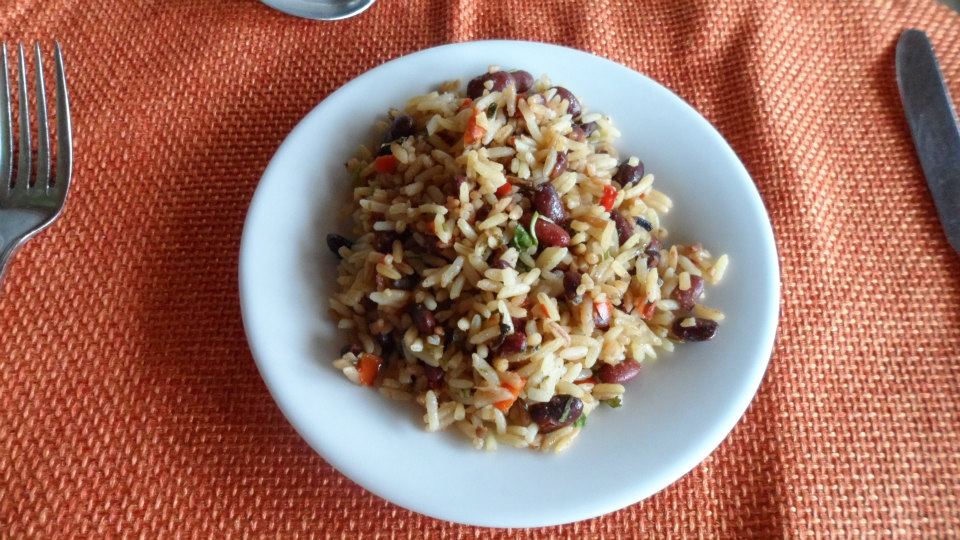
We did, however, learn that rice and beans are prevalent in Costa Rican cuisine and many Costa Ricans start their day with a dish of gallo pinto, a traditional dish made with these two staples.  I had gallo pinto for breakfast a handful of mornings and really enjoyed it.

GalloPinto

I find that when the topic of breakfast first comes up in my sessions, patients initially feel like they are limited to the usual options: cold cereals, hot cereals, bagels, eggs, bacon, waffles, muffins, pancakes, yogurt, etc.

What they come to realize though is that breakfast is just like any other meal of the day and we need not limit ourselves to the traditional breakfast options.  In other words, while breakfast options certainly include the typical options I listed above, they also include salads, sandwiches, entrees, or anything you might have at any other time of the day.  Gallo pinto is a perfect example.  Not too many Americans would typically consider rice and beans a breakfast option, yet they fill that role quite well for millions of Costa Ricans.

What might you consider having for breakfast if you expand your options beyond typical breakfast foods?

Where Dreams Literally Come True

Posted on by

The following blog entry appeared as a letter to the editor in the Wellesley Townsman on April 25, 2013.

I ran my last Boston marathon years before Joanne and I met.  Since then, she has occasionally asked me if I would ever consider running another one.   My response was always no, I could not envision a reason to do so.

The stretch of Boylston Street where Monday’s bombings occurred is special ground.  Every time I was on the verge of finishing the marathon, I took off my sunglasses as I made the left onto Boylston because I wanted the most raw, unfiltered absorption of the experience and atmosphere as I could have.  The straightaway is long, much longer than it appears on TV.  The finish line, in sight the entire time it takes to cover the distance, cues each runner to remember the reasons why he or she decided to race in the first place.  Throughout their unpleasant, cold, and mushy winter training, runners fantasize about running down Boylston with the crowd roaring, the finish line in sight.

That stretch of Boylston might be the only spot in the entire city where dreams literally come true for thousands of people every single year.

For many runners, finishing the marathon would be impossible without the support and encouragement of those along the route, including not just the volunteers, but also the spectators. They make the day what it is.  Without them, the marathon would not be an event, but rather just a bunch of people going out for a jog.  When I had to drop out of the 2004 race due to a medical problem, a complete stranger ran out her front door after seeing me collapse at the end of her driveway and cared for me until I was loaded into an ambulance.  More times than I can count, I saw struggling racers break out of their shuffling walks and back into jogs because somebody on the side of the road told them they could still do it.

A tragedy like Monday’s bombing would have been wrong no matter where it occurred.  If they blew up the local diner or bus stop instead of the Boston marathon finish line it would have still been wrong, but it would have been a different kind of wrong.  In a city where we tend to keep to our own circles, cut each other off and exchange middle fingers in traffic, and walk past each other without even batting an eye, the marathon is the antithesis: strangers act like best friends in order to build something overwhelmingly positive.  Somebody attacked that and tainted it.  They went after the city at its finest and hit us in the heart.

We need to get that back; we need to make that stretch of Boylston special again.

Many ways exist in which we can make that happen, none of which will be more significant than when thousands of spectators line Boylston Street again for next year’s race.  As for me, I am a runner, I have been my whole life.  It’s what I do.  Given that, I aim to establish a 2014 marathon charity team to fundraise for Monday’s victims, to enter the race as a member of that team, and to run down that Boyston straightaway slapping hands with every spectator I can reach.

George Etzweiler

Posted on by

I was going to continue “The Interior” series with two more entries in which I discuss foods like baking goods, nuts, and supplements.  However, people seem to already get the point that making sweeping generalizations about where to shop is not necessarily a great strategy, and I am wary of beating a dead horse.  If you are just dying to read what I wrote about almonds and cocoa though, send me an email.

I prefer to switch topics completely in order to share a photo I have been meaning to post for quite some time.

91YearOldThis is George Etzweiler, from State College, Pennsylvania, finishing the Mount Washington road race in 2011.  As he approached the finish line, virtually all of the spectators and runners who were still at the summit turned their attention to him and cheered.  Some of us (including me) took his picture.

At the time of this photo, Mr. Etzweiler was 91 years old.

He finished the race again in 2012, at the age of 92, with a faster time than he ran at age 89.

The Long Red Line

Posted on by

IMG_20130329_131830_891

A TV show that does spotlights on local businesses came down to our office the other day to film an episode about our practice.  After interviewing Joanne and me and filming a couple of mock sessions, the camerawoman took some video of the office itself.  When I noticed she was looking at the large map I have hanging on my wall, I explained to her that I rode my bicycle across the country for charity back in 2006 and the red line on the map snaking from Seattle to Boston is the route that we pedaled.

She was intrigued and asked me why I had not said anything about the bike ride when she was interviewing me.  As I was pausing to consider my answer, she offered, “I guess it doesn’t have much to do with nutrition, right?”  My immediate reaction was agreement; the trip had nothing to do with either our business or nutrition counseling.  Really, I had just put the map up for decoration and perhaps a conversation piece; therefore, I saw no reason to discuss it on a program about our practice.

As I told her more about the map and our ride though, I realized just how wrong my initial reaction was.

I kept that map in my backpack during the ride.  After each day’s trek, I took the map out and drew a short line with a red Sharpie indicating where we had biked that day.  I clearly remember being in Montana, looking at the vast distance from there back to Massachusetts, and having a hard time believing we would ever actually get to Boston.

Nobody bikes from Seattle to Boston overnight, and there are no shortcuts.  It takes waking up each morning and making a conscious decision to put in the work necessary to go to sleep somewhere a little farther east than the night before.  The daily progress sums over time, and with each day’s trip the ultimate destination grows closer.

What began as a short, red segment connecting Seattle to our first stop in Sedro-Woolley, Washington, grew into a gigantic, continent-spanning line because each day we resolved to progress a little bit closer to our goal.  Day after day, we shrunk the transcontinental distance that once seemed insurmountable until we were standing on a Massachusetts beach.

The more I think about it, the more it sounds exactly like the work we do here with our patients.