What to Eat Before/After Exercise?

Posted on by

We are always looking for suggestions for blog entry topics. This morning, a colleague messaged us on our Facebook page and asked us to write a piece on nutrition for student athletes. More specifically, she asked us to write about what a student-athlete should eat before and after a demanding workout.

Like most areas of nutrition, sports nutrition must be individualized. In other words, what works for your friend, teammate, brother, sister, etc. will not necessarily have you performing your best and vice versa, nor will the guidelines I outline below automatically work for you either. For that reason, I always suggest trying out a new eating routine on a practice day. Competition days are not for experimenting, but rather for eating the foods that you know from experience will have you performing up to the best of your capabilities.

In addition to individuality, other factors influence what and when we eat before exercise. Our main source of fuel during exercise is carbohydrates. Because of that, we want them to be the bulk of our intake before our workout. Their form, quantity, and combination with other foods depend on the intensity, duration, and mode of the upcoming workout.

Before a high-intensity bout of exercise, such as a cross-country race, we often need a greater amount of digestion time and a higher ratio of carbohydrates. For example, the student-athlete might have a plate of pasta with a small portion of grilled chicken at lunch in preparation for an afternoon race. If the athlete had the meal closer to race time, he or she may wish to ditch the chicken and have just the pasta, which will be more quickly absorbed in absence of the meat. Yogurt or toast with jam are other examples of small pre-exercise meals that work for some people. Someone who likes to fuel very closely to a high-intensity event might do better with a small amount of fruit or liquid nutrition, like Gatorade. Fruit juice is not ideal during this time; the high fructose content can cause gastrointestinal distress.

Before a low-intensity event, such as a long-distance bike ride or a game of baseball, people can often tolerate more well-rounded meals closer to exercise. Carbohydrate content should still be high, but more protein and fat can often be tolerated. Presence of the latter two macronutrients can also be helpful by slowing digestion and delaying the onset of hunger. Waffles with peanut butter, a burrito, or my previous example of pasta with chicken are examples of meals that can work well before an event of this caliber.

After exercise, our attention shifts from fueling to recovering. We have a short window of time (approximately 30-60 minutes) following exercise in which enzymatic activity is elevated and enables our bodies to be especially good at repairing muscles and replenishing glycogen stores during this time. For that reason, soon after exercise we want to consume both protein and carbohydrates. Examples include a small turkey sandwich, an apple with peanut butter, or yogurt.

Student-athletes often find themselves having to deal with a gap of time between finishing practice and when the family sits down to dinner, so having a post-practice snack that incorporates both protein and carbohydrates is going to be especially important. Taking advantage of this short window of time often necessitates bringing shelf-stable food that can tolerate being unrefrigerated from the time the student leaves home early in the morning to the afternoon after practice. Nuts, in combination with a carbohydrate source, such as fresh or dried fruit, often work well. Shelf-stable boxed milk or a product like Orgain, which is essentially protein-fortified milk, can also do the job.

Heavy sweaters and people who tend to lose a high amount of salt in their sweat (i.e. someone who leaves white streaks of salt deposits in exercise clothing) also need to focus on replenishing sodium. Gatorade Endurance or salted nuts, pretzels, popcorn, or tortilla chips are good options.

If you are a student-athlete and you would like individualized help with fueling yourself to perform your best, come see one of us or another registered dietitian who has expertise in sports nutrition.

He Said, She Said: Nutrition Facts Labels

Posted on by

He Said

Those working in policy are often charged with impossible tasks. Given the differences that make us each unique, coming up with guidelines that will work for some will inevitably alienate others. My suggestion is to abandon attempts to use food labels as nutrition-education tools and instead focus on accurately conveying the contents of the food itself.

Said attempts to provide education and context frequently result in nothing but confusion. Consider the inclusion of percent-of-daily-value calculations. If people understood that these percentages refer to the needs of a fictitious, generic example, fine, but I know from experience that all too often people are misled into believing these percentages pertain to them. Consider the differences in sodium needs of an individual with hypertension versus a marathoner who leaves white streaks of dried salt on his singlet.

Along those same lines, people misunderstand the term “serving” and think they are supposed to have the specified amount. Aiming for the serving size can lead to overeating or undereating and trigger negative feelings, such as guilt. In reality, serving size is not a mandate, but rather a unit label that gives us shorthand language with which to talk about and compare foods. I would like to see the term “serving” removed and replaced with less loaded term, such as “unit,” that still serves the function of easy discussion but without the baggage.

Another one of my gripes with food labels is the rounding off that manufacturers are legally allowed to do with their numbers. For example, if a food has less than 0.5 grams of trans fat per serving, they can round down to zero. In a way, it makes sense. A piece of paper is so thin that we might call it two-dimensional. Gather a bunch of papers together into a ream, however, and suddenly the thickness is substantial. That is the problem with rounding. Joanne has a patient who was using a pump margarine that stated it was calorie-free, but she was using such a high quantity that the calories, which had legally been rounded down to zero, significantly accumulated.

Rounding also happens in a qualitative sense on the ingredient list. What exactly are “natural flavors,” for example? People should have the right to know exactly what they are consuming, and more detailed information would surely make life easier for people with food allergies.

Nutrition education is certainly needed in our society, but food labels are not the place for it.

She Said

Ah, the nutrition label. As a practitioner specializing in eating disorders (EDs), I am well aware of how the nutrition label has the potential to be used (and abused). Many of my clients could spend an hour or more in the grocery store, looking at label after label to find the healthiest food option. I had one patient tell me that she spent 30 minutes in the cereal aisle comparing labels for different types of granola, determined to find the one that had the least amount of carbohydrates and fat, while also boasting at least five grams of fiber. And, of course, the ingredient label needed to have less than 10 ingredients listed, most of the items needed to be organic, etc.

You see, for those struggling with EDs, the nutrition label is not usually their friend. Nutrition label reading is a practice in self-torture for most of them. Having that information listed on the box or bag gives the eating disordered individual the information he or she needs to make choices about his or her eating, and it often causes them to analyze and over-analyze their food choices. In some cases, my patients will refuse to look at labels altogether for fear of getting sucked down the rabbit hole of “healthiest choice.”

For most of my ED patients, I suggest that they avoid reading the nutrition labels. Why? Well, for one, to prevent the above scenario from playing out at every grocery shopping trip. Also, my goal for most of my patients is to learn to engage in Intuitive Eating (IE), and using nutrition labels to make food-based decisions (when one is struggling with an ED) is anything but intuitive; instead, it is using an external control to decide what one should eat. Ideally, I would prefer the patient choose the type of granola she enjoys eating the most, regardless of the amount of carbs, fat, or fiber grams it contains. As I have noted before, when we enjoy what we are eating, we are more likely to absorb the nutrients in that food than if we simply choke down a less yummy version of that food.

Of course, if someone has a health condition that warrants them to read labels (e.g. diabetes or celiac disease), I would suggest that they do so in order to be safe and as a health-promoting behavior. But if someone has no dietary restrictions placed upon them by their doctor, and they are struggling with an ED, avoiding the nutrition label is the way to go.

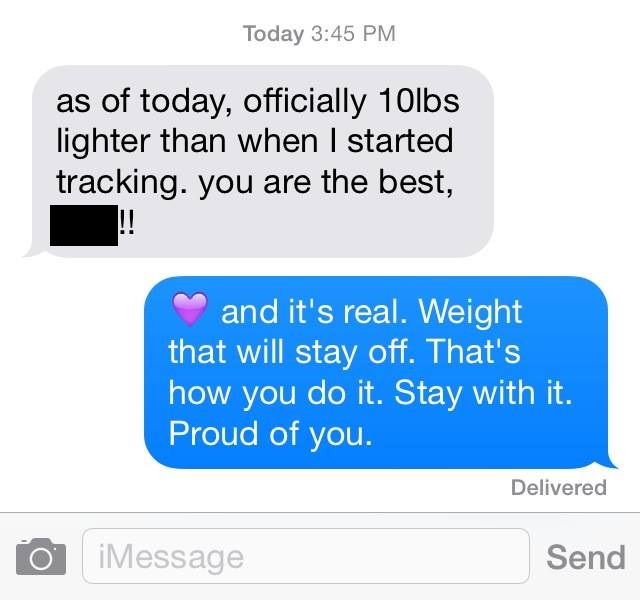
Weight Loss Specialist

Posted on by

“Luck is the last dying wish of those who want to believe that winning can happen by accident. Sweat is for those who know it’s a choice.”

Suggesting that achieving our goals is up to us if only we work hard enough sounds motivating on the surface, but really it makes no sense. So, what, the 99.2% of players in the U.S. Open main draws who walked away without a title did not realize all they had to do was work hard and choose to win? Outcomes that rely on factors beyond our control breaking our way are not automatically there for the taking if only we put our mind to it.

Where that quote originally comes from is not clear to me, but I know I first heard it from a personal trainer who cites it as one of his favorite quotes. According to said trainer’s Facebook page, he now employs a certified “Weight Loss Specialist.” Awesome.

Here is the problem: If a supposed specialist is giving you the information you supposedly need to lose weight, and achieving your goal is framed as a choice that is entirely in your control and can be attained through hard work, and you do not achieve your weight-loss goal, then who is to blame?

You.

If we mislead people into believing that weight loss is entirely up to them and they do not achieve (or more likely maintain) it, they typically turn their frustration and disappointment on themselves with berating thoughts like, “I have no willpower,” “I need to be more disciplined,” “I’m such a loser,” and “I just need to work harder next time.”

Behaviors that in and of themselves were beneficial to health independent of weight loss, such as being physically active or eating fruits and vegetables, are abandoned because they did not lead to weight loss. Restriction gets taken up a notch. They pursue an even more rigid diet and/or intense exercise regimen, not realizing that these behaviors themselves can make weight increase and/or lead to health issues. A colleague of mine calls it “paradigm blindness.” In other words, many people do not realize that their presumed solution to being “overweight” actually exacerbates the condition, so they keep adding more of the supposed solution to the ever-worsening issue.

I used to help (and I use that verb loosely, as I was actually part of the problem even as I thought I was part of the solution) people with weight loss earlier in my career too, but that was before I knew better.

Well-constructed research, my clinical experience, and the experiences of many of my fellow dietitians teach us that weight loss is typically not in one’s control. Sure, our behaviors do matter, but other factors, such as genetics, environment, medical conditions, and personal history, are either partially or completely out of our hands.

The paradox is that any true “Weight Loss Specialist” would know that nobody by that title actually exists. Healthcare practitioners are supposed to help people with, you know, health, which is why Joanne and I take the focus off of weight and instead focus on behaviors that can actually make a difference.

He Said, She Said: Protein

Posted on by

He Said

Most Americans get more than enough protein. Dietitians think about protein needs in terms of grams of protein per kilogram of body weight (g/kg). For the average person, 0.8 to 1.0 g/kg is perfectly adequate. For a 160-pound individual, this translates to a range of 58 to 73 grams per day of protein. Someone who is extremely active or has elevated protein needs due to a medical condition, such as recovery from surgery, may need more in the range of 1.2 to 1.5 g/kg. Those of us who suffer the misfortune of life-threatening traumas, infections, and burns need upwards of 2.0 to 3.0 g/kg as our bodies fight to survive and rebuild themselves. Under these circumstances, my example of a 160-pound person would need 146 to 219 grams per day during recovery.

So why is it then that we routinely see patients who are feeding themselves as much protein as a hospitalized third-degree burn victim? Among the multiple reasons, the most significant seems to be misinformation that spreads rapidly in our weight-centered society. Those of you who are my age or older have been around long enough to remember the low-fat fad that passed through a couple of decades ago. Just like fat phobia, today’s high-protein craze is based less on science and more on fear and a desperate feeling to grab hold of something, anything, that might be an answer to weight control. Accuracy of said answer is a distant concern.

An excessive protein intake comes at a cost. If we are consuming too much protein, only two possible scenarios exist: (1) We are consuming too few of other nutrients in order to make room for the protein, so we face the risks associated with inadequate intakes of other necessary nutrients. (2) We are still consuming adequate amounts of other nutrients, which means our overall caloric intake is excessive, and we have to deal with the ramifications of taking in more energy than our bodies need. Joanne offers additional concerns in her She Said section below.

When my patients work on building their intuitive-eating skills, oftentimes they discover that they feel better (i.e., greater energy, more regular bowel function, happier mood, etc.) when their protein intakes decrease to the recommended ranges in order to create appropriate room for healthy carbohydrates and fats.


She Said

In my work with those struggling with eating disorders, it seems as if protein can do no wrong. Nine times out of 10, my patients find protein to be much more benign than carbohydrate or fat. It is not unusual for a patient to report to me that all she has been eating is vegetables, some fruit, and egg whites/cottage cheese/boneless, skinless chicken breast/fish, while steering clear of bread, sweets, oils, and butter. When posed with the question about why she is avoiding the other macronutrients, the fallback answer is, “Well, protein is healthy for you, and carbs and fats will make me fat, so I don’t eat them.”

The logic behind this assumption is flawed for a few reasons. First, while it is possible to gain weight if one eats too much carbohydrate or fat, the same could be said for protein as well. Excess calories from any macronutrient will result in weight gain (to varying degrees). 500 extra calories of protein equal 500 extra calories of carbohydrate equal 500 extra calories of fat. It doesn’t matter a whole lot where those calories are coming from: If your body doesn’t need that extra fuel, it will store it.

Second, by eschewing carbohydrates and fats, one is losing out on a ton of nutrients. For example, fat-soluble vitamins A, D, E, and K are virtually impossible to absorb if they aren’t eaten in the presence of fat. This means that all of that vitamin A found in your carrots and all of that vitamin K found in your dark leafy greens will pass right through you if you don’t eat them with fat (like that found in salad dressing). Carbohydrates are also a gold mine of nutrients: Whole grains found in many breads, crackers and pastas provide fiber to keep us regular and can help manage our cholesterol levels. Carbohydrates are also the building blocks of serotonin, a neurotransmitter in the brain that is responsible for feelings of well-being and happiness. Protein can’t do any of the above by itself.

Finally, there is such a thing as too much protein. In general, it is recommended that healthy adults take in 0.8-1.0 grams of protein per kilogram of body weight. That translates to approximately 67 grams per day for an average man and 57 grams per day for an average woman. Most Americans get more than enough protein in their diets without cutting back on carbohydrates or fats. What does a typical day of protein intake look like? Well, let’s say you have two scrambled eggs for breakfast – there’s 12 grams of protein already. For lunch, you have a turkey and cheese sandwich – there’s another 32 grams of protein. Dinnertime is fish with veggies – another 25 grams of protein. That amounts to 69 grams of protein, which is more than enough. Many of my patients will confess to having double or sometimes even triple that amount, which is troubling. Excess intake of protein can take a serious toll on your kidneys, as they will work overtime to filter out the byproducts of protein breakdown. What could that mean? Kidney failure.

Protein is a valuable nutrient, to be sure. But overdoing it on any one macronutrient is not only potentially harmful to one’s body; one could be missing out on many other nutrients from other sources.

Noms: The Rice Barn, Needham

Posted on by

Just last week, we moved from Brookline to the town of Needham. Since our kitchen is still under construction, we’ve been forced to eat out more than we normally do. Given this, we thought it would be fun to write a review of a Needham restaurant we had never been to before: The Rice Barn.

Located right in Needham Center, The Rice Barn is the premier Thai food restaurant in town. While the inside of the establishment is a bit more upscale than we are used to, the atmosphere is far from stuffy, and the menu is very accessible. The restaurant website explains that its menu offers a “diverse selection of dishes,” including Thai traditional village delicacies as well as flavors from other parts of Asia. Among some of the options are various noodle dishes like Chinatown Street Noodle, which is inspired by Bangkok’s Chinatown; Saigon Beef, which is a traditional dish from Vietnam; and Chiang Mai Noodle, which is described as a “wonderful ethnic dish from northern Thailand, influenced by Burmese cuisine.”

While we are somewhat adventurous eaters in general, we decided to stick with the more popular options that we recognized from other Asian establishments. Joanne started with a lovely take on wonton soup, with a warm, rich broth and perfect pork-stuffed wontons. For main dishes, Jonah went with the special yellow curry, which boasted shrimp, avocado, and mango paired with rice. Joanne opted for the traditional pad Thai with shrimp. Both dishes were delightful. Joanne commented that her pad Thai was one of the best she had ever had. Jonah was very pleased with his curry, especially enjoying the flavorful curry sauce, but he found the avocado to be a bit overwhelming in amount, as he was given nearly half of an avocado with the dish. The perfectly cooked rice that came with Jonah’s curry was served in a beautiful pyramid configuration, with white rice at the bottom and brown rice at the top.

The best part of both meals was that The Rice Barn did not scrimp on the shrimp! At other establishments, we often receive only three or four shrimp in a dish, but we counted that each of us got about eight shrimp, which is double what we expected. And while the menu prices at The Rice Barn are not cheap, we felt like we got a good amount of food for our money. The service was friendly and prompt, and we thoroughly enjoyed our time there. When we return, we will try to be a bit more adventurous with our menu selections.

ASDAH, Please Reconsider the ®

Posted on by

Our practice was using the Health at Every Size® (HAES®) model before I even knew it went by that name. My personal and academic backgrounds, the legitimate research I had read, and my clinical experience all pointed towards a health-centered, rather than a weight-centered, model of care.

Earlier this year, we learned about the Association for Size Diversity and Health (ASDAH) from Green Mountain at Fox Run, a program to which a colleague had pointed us. Because we happened to agree with everything we knew about the association, we became proud members. Then I discovered one point on which our opinions differ: the requirement that the ® symbol must follow mention of the HAES® approach.

I understand the advantage of having a title for our approach. By naming it, we can succinctly communicate in a universally-understood fashion how we go about our work, find like-minded individuals in online communities, and separate ourselves from others who take a different approach to health. Entitling different approaches has precedent, just as labels like cognitive-behavioral, interpersonal, humanistic, and psychodynamic denote different techniques that fall under the umbrella of psychotherapy. Notice, however, that none of these names have an ® attached.

Know who does use the ®? PointsPlus®, Nutrisystem®, Medifast®, FirstLine Therapy®, Atkins®, HMR®, and similar ilk. By including the ®, we take the HAES® approach out of the realm of legitimate, evidence-based models of healthcare and put it smack in the middle of gimmicky programs that sacrifice health for money. Call it guilt by association; in essence, the HAES® community loses credibility because of the company we are inadvertently choosing to keep.

Concern and confusion lies on both sides of the counseling room. From the patients’ perspective, the ® makes some of them feel like they are being sold a program, as if their practitioners are nothing more than local distributors for a product so standardized it bares no discernible differences if bought on one side of the world or the other. From my perspective as a practitioner, I have chosen to align myself with ASDAH because of our common approach to healthcare, but at the same time we are separate entities with neither one of us speaking for the other. In that sense, the ® feels like a threat to my professional independence.

Because of the ® and the concerns and confusion that it brings, I stay away from using the term HAES® on our website. Instead, we have come up with our own synonymous language to convey the same concept. In doing so though, we lose the universal recognition of the HAES® name and its associated benefits. How nice it would be to able to write HAES and just leave it at that.

If my understanding is correct, the founding members of ASDAH took a great deal of professional risk by going against widely-held beliefs, building the association, and formalizing the HAES® approach. For everything they did, they have my gratitude and admiration. However, just because ASDAH can require the ® does not mean it should. There is a better approach, a solution that will convey the same meaning yet decrease patient confusion and increase practitioner credibility: Drop the ® requirement.

Warning Bells

Posted on by

The following piece was written by KC, the mother of one of our patients.

I heard the faint warning bell early but didn’t really want to believe it. When she got in the car after a trip visiting a friend and asked if I noticed that she had lost weight, when she started to eat “healthy,” when she became “lactose intolerant” (really? since when?) and couldn’t eat ice cream, when chicken repulsed her– all of these behaviors I noticed. The running and working out increased but it was under the guise of getting ready for fall practices. I started to get nervous, but I kept waiting for her to get tired of the running, to get tired of reading labels. This was my daughter who never considered her size– who would happily try on any clothes– and only knew her weight when she went to the pediatrician. It was not until she told me her weight one morning, at which point I said, “Enough!” and then a week later told me, with what I thought at the time was a rather smug smile, that she had dropped another four pounds that I heard the cathedral bells tolling loud and clear.

I spent the next six weeks taking her to the pediatrician in the practice who was the most knowledgeable about eating disorders– mistake #1– I should have taken her directly to a specialist. She also began therapy with a psychologist who was finishing up her doctorate and had “some experience” with eating disorders– mistake #2. Being referred to Joanne as her nutritionist was the only step she made towards recovery in those first six weeks. I remember clearly my daughter’s initial visit to Joanne because it was the first time I felt I had an ally in the battle against the eating disorder. My daughter sat perched on the end of a chair with a sweatshirt and a down coat on clutching a cup of black coffee while I sat there sweating because it was so hot in the office. Joanne was extremely patient and kind while explaining her meal plan in spite of my daughter’s overt hostility. My daughter contained herself until she reached our car and then started to sob. Uncontrollably sob. Crying was nothing new in our house– she had been doing it daily for months– but looking back I realize it was the first time someone challenged the eating disorder, and it was angry.

The six weeks prior to my daughter entering a treatment facility were incredibly painful. I ate every meal and every snack with her when she was home. And it took her forever. Plus it drove me crazy the way she ate each meal– veggies first then protein then the grain. There were many forbidden topics in our house. No one could discuss exercise or bodies or food. What went on the plate had to be eaten. No one could say that he or she was full halfway through the meal. The list went on. And again, she cried all the time. At one point she confessed that prior to the meal plan, if she ate two apples and a bowl of soup as her food for the day she could tell herself at night that she had done a good job. I learned later that it was actually the eating disorder praising her. After she showered, I would find fistfuls of hair in the drain. She had a bald spot in the front of her head. We took the full length mirror out of her room. I packed up all the clothes that she used to body check and gave them to the Red Cross. She wore pajama pants, baggy shirts, and sweatshirts. Her behavior became child-like– she wanted to sit on my lap, sleep with me, wouldn’t leave my side. We could no longer go out for dinner as a family or a couple. It was far too stressful. When I was not with her, I worried that she was throwing her food into the garbage disposal– when she did come, no one could enjoy his meal– the tension and anxiety emanating from her was palatable. When my husband and I were finally able to get an appointment at Children’s for an evaluation, he expressed concern about her being taken out of school– not to be a part of the peer group. I had to bluntly tell him that our daughter was already gone, and the only hope we had to get her back was residential treatment.

It was frankly a relief when she finally entered treatment. I can honestly say that I could not handle her disorder on my own, and she needed good professional care. Picking the treatment facility is a personal choice, but I am very glad she landed where she did. Her case worker was incredible, and the women who managed her daily were loving but firm. She stayed for a period of time, and we began to measure the success of a day by how many boosts she had to drink or not. I’d like to say that she came out of treatment fully recovered but that was, of course, not the case. I was extremely lucky to be able to put together a post-treatment team for my daughter whom she embraced and respected. Her school was incredibly supportive, but I have heard horror stories where schools have not been. Families who have been told that no allowances would be made– it was either sink or swim. I will be forever grateful to her school administrators for working with and not against my daughter. An acquaintance whose child was a recovering anorexic visited with me while my daughter was in treatment. She imparted some wisdom which I found to be extremely helpful. One, it is not her fault. Two, following the meal plan and finishing her meals is non-negotiable. There is no negotiating with the eating disorder. And finally three supports, love, prayer (if that is one’s thing), and food will help to battle against the eating disorder.

It helped me to think of the eating disorder as a separate entity from my daughter. A few months after she got home from treatment, I made a flippant comment, and she laughed, really laughed. It was her first spontaneous expression of joy in months. I am so proud of her because she has worked incredibly hard to separate herself from the eating disorder. She has listened to her team, gone to therapy, followed her meal plan, and found books on her own to study. She has also developed a spiritual side to her personality which in our barely-go-to-church-on-Christmas family is a wonder to see. She has embraced her treatment and truly wants to get well. Does all this mean she has fully recovered? No, she has not. There have been setbacks, but I am extremely hopeful that she will live a full joy-filled life which has no room for an eating disorder.

Obesity Cuts Life Expectancy, Santa Is Responsible for Your Christmas Presents, and Other Misleading Statements

Posted on by

My interest in writing a blog right now is pretty much nil, but I cannot let today’s misleading boston.com article entitled “Obesity Cuts Life Expectancy by Up to 14 Years, Study Shows” go by without reacting, for I know the damage that pieces like this do to people, including some of my patients.

Long story short: The researchers who authored the primary source article did not adequately control for behaviors. They screened out potential participants who had ever smoked and/or had a history of certain diseases, but the lifestyle behavior information they collected from participants was limited to alcohol use and physical activity level. Researchers collected no information about other lifestyle factors, like stress management and eating and sleeping habits, all of which can impact health. The behavioral data they did collect was self reported, which introduces all sorts of error. Other research has shown that when behaviors are controlled for, body weight does not seem to matter, but the study design that these authors used prohibited any opportunity from being able to confirm or refute those findings.

The boston.com piece discusses a second article as well that examined the relationship between obesity and exercise. In reference to this latter article, the boston.com piece’s subheading concludes with, “And it’s under-exercise, not overeating, that’s causing America’s [obesity] epidemic.” That eye-catching text will certainly garner many clicks, which is unfortunate because it is not true. The actual research piece reads, “The research highlights the correlation between obesity and sedentary lifestyles, but because it is an observational study, it does not address the possible causal link between inactivity and weight gain.”

I cannot stress it enough: Correlation is not causation. They are entirely different. I know, I know, we each know somebody who has put on weight after they stopped working out. Sure, that does happen sometimes, but on the macroscopic level that is the population, the picture is much more complex than that with many other factors in play.

The boston.com article’s final paragraph begins with, “Losing weight is proven to significantly reverse the health effects of obesity.” Wrong. When we adapt healthier lifestyle behaviors, our body weight might change as well, but if we credit the weight change instead of the behavior change then we have it backwards.

The harm in all of this is that it reinforces a weight-centered model of eating and physical activity that ultimately fails nearly everybody who uses it. If we take a weight-centered approach and do not maintain the weight we want, we risk losing motivation and reverting to old behaviors because the goal was unattainable.

There is a better way. In the health-centered model that we advocate, the behaviors in and of themselves matter independent of weight. Whether weight goes up, down, or stays the same is irrelevant because the behaviors themselves are what count. Better-designed research seems to support this model: When we control for behaviors, health and weight look to be independent.

Physical Activity: So Much More Than Burning Calories

Posted on by

“Just finished a seven-mile run – definitely earned the right to splurge at the party tonight!”

“I play tennis six times per week to keep my weight in check and to be able to eat what I want.”

“Just gorged at my friend’s Fourth of July cookout – looks like I will need to hit the gym extra hard to burn all those calories off!”

The above are just some of the comments I have either seen posted on Facebook or heard in conversation over the past few weeks. While these types of comments are quite common and universally agreed upon, I have a problem with them for a few reasons.

There is an abundance of evidence that exercise improves one’s health. It not only has been proven to improve blood pressure, blood lipid profiles, inflammation, and heart health in general, it has also been found to help the processing of glucose and insulin as well. But despite all of these positive findings, there is very little scientific evidence that exercise is an effective way to control weight and that exercise by itself does not have as much of an impact on our metabolism as most people think it does.

In one study, a group of volunteers from a hunting and gathering tribe in Tanzania were studied to see if there was a link between their activity levels and the number of calories they burned in a day. While it was true that the tribe members were much more active than the average American, walking about 7 miles per day on average, their metabolic rates were about the same as the average metabolic rate for Westerners. That means that despite the fact that the tribe members were doing significantly more physical activity than Westerners, they were burning the same number of calories as Westerners. Their increased activity did not mean they burned more calories.

Aside from the problematic idea about using exercise as a weight control mechanism, the bigger problem I have is the common belief that exercise’s only benefit is to burn calories. I know so many people who run regularly, not because they love to run, but rather because they are repenting for their dietary “sins.” Whatever happened to being physically active because we enjoy the way it makes us feel? Whatever happened to playing a friendly game of pick-up basketball for the sheer fun of it? Or jumping into the pool on a hot summer day to cool off and splash around? So many of us view exercise as a way to punish our bodies into submission rather than as a way to feel more alive and appreciate what our bodies can do.

How about we start using physical activity as a way to connect with our bodies and enjoy what they can do for us? How about engaging in exercise as a way to improve our health and help our bodies to function at their best? Or taking up a sport for the thrill of the game? The benefits of physical activity are so much more than simply burning off last night’s nachos. And no one needs to “earn” the right to eat what he or she wants. That is no way to live life.

Day 91: Progress (or Lack Thereof)

Posted on by

Today was supposed to be my day. Circled on my calendar back in March, today was my three-month CT scan and appointment with my surgeon. Although full recovery from a surgery of this magnitude takes right around a year, three months is considered enough time for sufficient healing to take place that allows for a return to normal activities. My expectation was that I would come home from the appointment and go right out for a run, my first in nine months.

As it turns out, I will not be running anytime soon. The surgeon used bone grafts to build two columns in my lower back. The CT scan showed that the column on the right is healing as expected, while the column on the left is far behind schedule. The chunks of bone that he implanted on the left are still sitting there independently with only minimal growth around them.

The surgeon said this is highly unusual. Typically, people either heal well bilaterally, or they heal poorly bilaterally, but two different progressions simultaneously is rare. He has no explanation as to what happened. He tells me that on paper I am the ideal candidate to heal well: young, active, non-smoker, healthy eating habits, etc. “On paper,” therefore, seems to be the key term.

Instead of today being my last appointment with him, now I have plans to see him again in mid-August, at which time I will undergo more tests to check how the bone is healing. Perhaps the fusions will progress between now and then, or perhaps they will not.

In the meantime, I am feeling very discouraged and disappointed. There will be no bike rides this summer. My planned return to competitive running on the one-year anniversary of my last race is out the window. So much for playing ping pong with my nephews when they visit over Independence Day weekend. I will not be able to help pack, unpack, and set up our first house when Joanne and I move later this summer. When I pan across the horizon of my life, tennis is nowhere to be seen.

Instead, I have two months ahead of more of the same. Three months ago, I thought June 18th would never come. In reality, the time passed just as slowly as I anticipated it would. To think I was done and then find out I have to do it almost all over again, but with more uncertainty and less optimism this time, is quite disheartening.

The other day, a new patient came to me frustrated that his efforts to lose weight have gone nowhere. When I suggested that we try a different approach by focusing on making healthy choices, learning to love and accept himself regardless of his size, and letting his weight settle wherever it naturally belongs, well, he did not want to hear that one bit.

He looked down at my lean frame and explained to me that I do not know what it is like to be judged on appearance, that I do not know what it is like to feel uncomfortable in my own body, that I do not know how frustrating it is for my body to not respond the way I would like despite my best efforts, and that I do understand the apparent unfairness of seeing somebody with an attribute or an ability that I covet, but cannot attain, for myself. Yeah, clearly I cannot relate to any of those themes at all.

Everybody is dealing with something, and while the particulars are unique to each person, common ground exists underneath. No matter what our goals are, if we do the best we can to achieve them and we still fall short, then by definition there is nothing more for us to do except adapt and find a new way to thrive. When I wrote, “In this kind of defeat, you learn that there are incidents in life that are not up to us. We are only somewhat in control of our own destiny, and we have to roll with events and outcomes that do not go our way,” I feared that perhaps I was foreshadowing my own outcome.

Maybe that will prove to indeed be the case. However, I am not going to use that as an excuse to keep from doing everything I can, while still maintaining perspective, to meet my goals. Today sucked, but my bitching is over. It’s time to get back to work.